
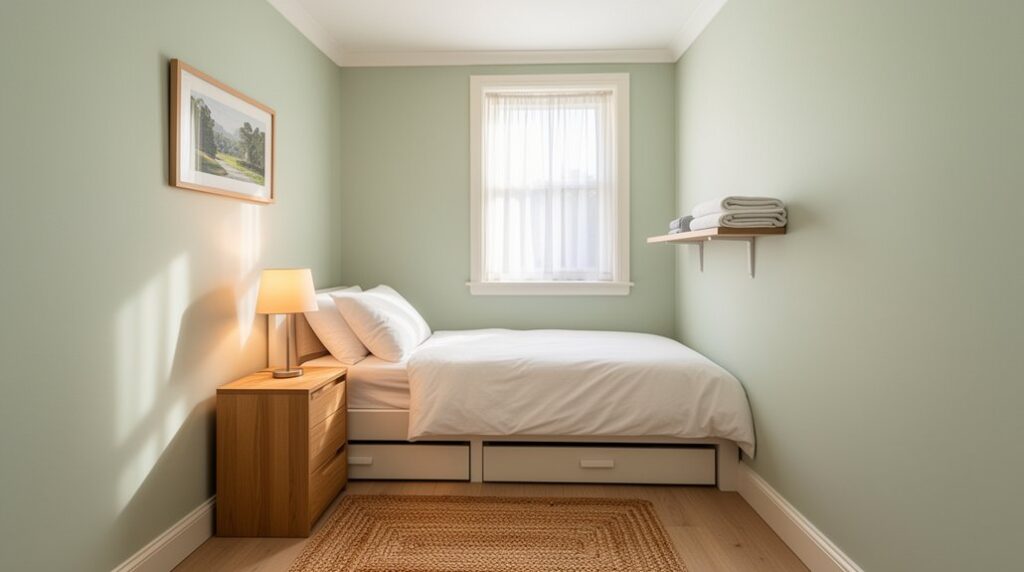

Is it really true that a box room can’t work as a guest bedroom without feeling cramped? You can prove otherwise by measuring precisely, protecting a 600mm walkway, and choosing a slim single or daybed in pale finishes. You’ll shift storage onto walls, tuck drawers under the bed, and use an over-door organizer to keep the floor clean. Then light, mirrors, and one calm statement artwork do the heavy lifting—but the bed choice changes everything…
Measure Your Box Room + Key Clearances
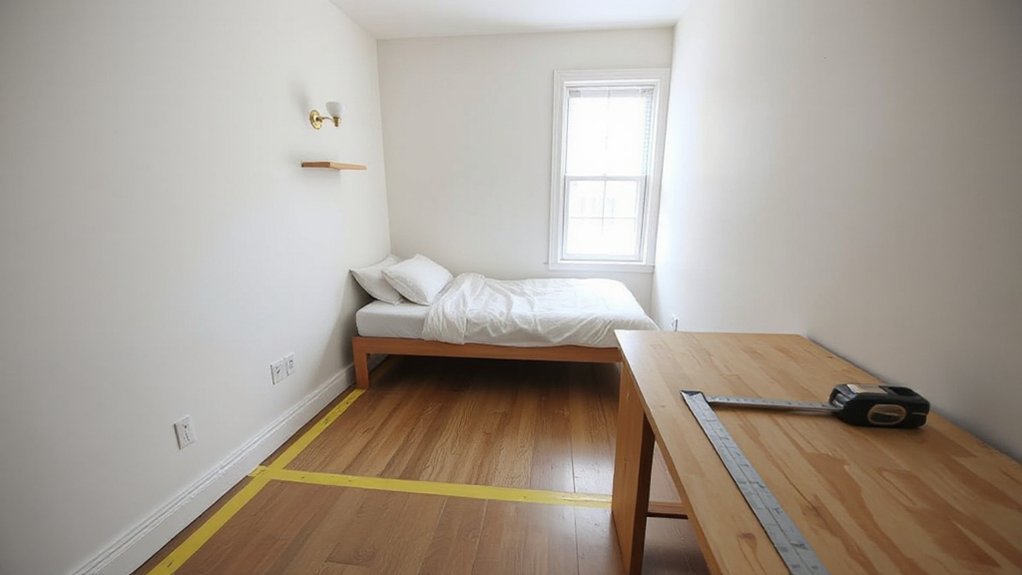
Before you buy anything, measure your box room wall-to-wall, floor-to-ceiling, and note every obstruction—skirting boards, radiators, window reveals, sockets, and door swing—because these details dictate what’ll actually fit. Sketch a quick plan and mark usable “clean” rectangles, not just the headline dimensions.
Keep a minimum 600mm walkway where you’ll pass daily; if you can’t, route circulation along one side and keep corners visually open. Check door swing clearance or swap to an outward or sliding option.
Measure radiator projection so furniture doesn’t choke heat or look cramped. Confirm window reveal depth for blinds and headboard lines.
Then align furniture arrangement with your sightlines: longest run feels calmer. Tie measurements to color schemes—lighter walls widen, darker accents define zones.
Pick the Best Bed for a Box Room
Because the bed dominates both floor space and sightlines in a box room, you’ll get the best result by choosing for footprint, access, and visual weight—not just mattress size.
Start with a small double or standard double only if you can keep at least one clear side for entry; otherwise choose a single or daybed profile.
Favor slim frames, tapered legs, and low headboards so light travels and the room reads taller.
Skip bulky footboards that block your furniture arrangement and make circulation feel pinched.
If the bed must sit against a wall, choose an upholstered headboard that looks finished from the door.
Match finishes to your color schemes: pale wood, soft neutrals, or a dark frame for crisp contrast without visual clutter.
Add Box Room Storage (Walls, Under-Bed, Over-Door)
Even if your floor plan feels maxed out, you can add serious storage in a box room by pushing it upward and into the “dead zones” around the bed and door. Start with wall-mounted shelves above the headboard for books and a small tray; keep depth shallow to protect headroom and sightlines. Add a slim picture ledge to display art without visual bulk.
For under-bed storage, use lidded boxes or zip bags on low-profile sliders, and label them for fast turnover between guests. If you’ve got a divan, dedicate drawers to spare linens and towels.
Over the door, hang a rail or pocket organizer for hangers, slippers, and travel-size toiletries. These storage solutions keep surfaces clear and support ruthless space optimization. Choose matching finishes to stay calm and cohesive.
Make a Box Room Feel Bigger With Lighting
Once you’ve pushed storage up the walls and off the floor, lighting does the next big job: it stretches the room visually and makes the layout feel intentional rather than cramped.
Maximise natural light by keeping window treatments minimal, mounting curtains high and wide, and using sheer fabrics that don’t block the glass. Place a mirror opposite or adjacent to the window to bounce daylight deeper into the room.
Layer illumination: a flush or semi-flush ceiling fixture for even spread, plus slim wall sconces or a clip-on reading light to free bedside surface.
Choose warm-white LED lighting (around 2700–3000K) with dimmers so guests can soften glare at night. Aim light at walls and the ceiling to lift edges and reduce shadows. Avoid one harsh central bulb.
Choose Clutter-Free Décor for a Box Room Guest Room
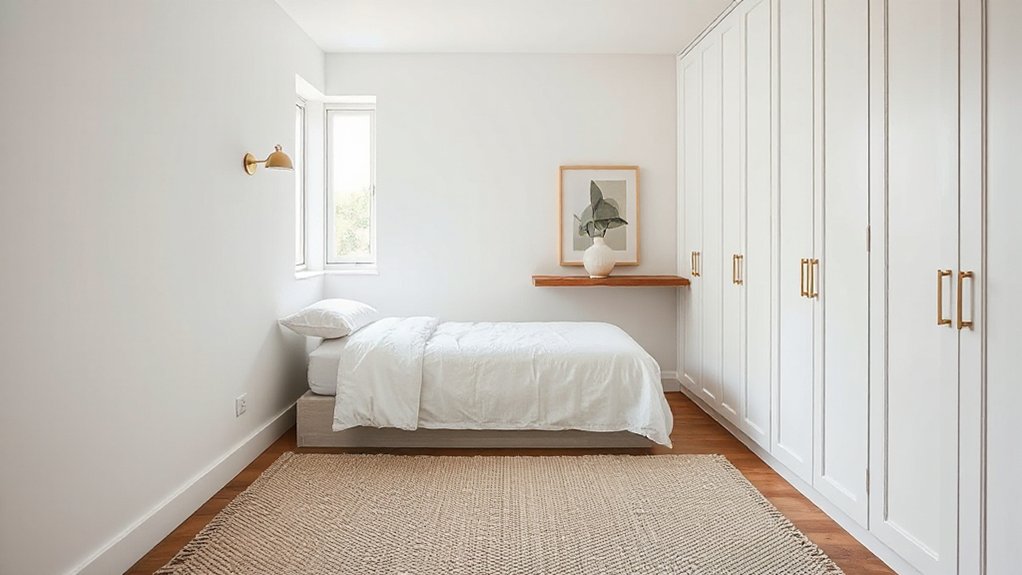
Keep your box room guest space visually calm by choosing minimalist wall art—one oversized print or a tight pair of slim-framed pieces beats a busy gallery wall. Stick to a restrained palette and clean lines so the walls read taller and the room feels edited, not crowded.
Then layer in multi-use décor accents like a lidded storage ottoman, a tray-topped nightstand, or a mirror with hooks, so every “pretty” item earns its footprint.
Minimalist Wall Art Choices
Because a box room can’t afford visual noise, choose minimalist wall art that adds polish without shrinking the space. Limit yourself to one focal piece above the bed or on the longest wall; anything more reads busy. Pick statement wall art with clean geometry, thin frames, and generous negative space to keep edges crisp.
Use abstract color palettes that echo your bedding: two neutrals plus one muted accent works best. Keep scale intentional—aim for art that spans about two-thirds of the headboard width, or a single tall print to emphasize height. Hang it with the center at eye level (about 57 inches) and align it to furniture edges for a tailored look.
Favor matte finishes over glare so the room feels calm, not shiny.
Multi-Use Décor Accents
While a box room needs warmth, it can’t spare surface space, so choose décor accents that earn their footprint. Start with a wall-mounted swing-arm sconce or plug-in reading light to free the bedside top. Add a narrow picture ledge that displays two frames and doubles as a landing strip for a phone.
Use an ottoman with hidden storage as both luggage stand and extra seat, and drape a textured throw for softness. Keep color schemes tight: repeat one metal finish and two neutrals, then add a single accent hue in cushions.
Let mirrors work harder—hang one opposite the window to bounce light and visually widen furniture arrangements. Finish with a small lidded tray to corral keys and chargers.
Guest Essentials That Fit in a Small Box Room
Even if your box room barely fits the bed, you can still stock it with guest essentials that feel intentional, not cluttered. Start with Luxury bedding: crisp white sheets, a medium-weight duvet, and one textured throw that adds polish without bulk. Keep two pillows per guest, but store spares in a vacuum bag under the mattress.
Choose Compact furniture that earns its footprint: a wall-mounted shelf as a nightstand, a slim hook rail for coats, and a fold-flat luggage rack that tucks behind the door. Add a narrow basket for towels and a labeled tray for water, tissues, and chargers.
Use a clip-on reading light to free surfaces, and hang a full-length mirror to brighten the room and expand it visually. Keep everything coordinated, calm, and easy to reset.
Frequently Asked Questions
Can I Legally Use a Box Room as a Bedroom in My Area?
You can, but you must check your local building codes for minimum room size, ceiling height, egress window, and smoke alarms. Decorating tips and furniture selection help, yet legality hinges on compliance. Verify with council.
How Do I Improve Ventilation and Prevent Damp in a Small Guest Room?
You’ll cut damp risk by boosting Airflow circulation and tightening moisture control—indoor humidity above 60% often triggers mold. Crack windows daily, run an extractor or dehumidifier, keep furniture off walls, and use hygrometer readings.
What’s the Best Way to Soundproof a Box Room for Sleeping Guests?
You’ll get the best sleep-focused soundproofing by sealing gaps, adding dense soundproofing materials, and layering soft finishes. Use noise reduction techniques: door sweep, perimeter seals, heavy curtains, thick rug, acoustic panels—matched to décor.
Do I Need Planning Permission or Landlord Approval to Convert the Box Room?
You usually won’t need planning permission, but you’ll need landlord approval if you rent—like a captain altering a cabin. Check lease, building rules, and fire safety. Keep Interior decor light; choose Storage solutions that don’t alter structure.
How Can I Add Heating or Improve Temperature Control in a Box Room?
You can improve comfort with radiator installation or a slim electric panel heater, then add thermostat controls for precise zoning. Seal drafts, add thick curtains, and lay a rug. Use a quiet fan for circulation.
Conclusion
You’ve turned a once-cramped box room into a guest-ready retreat: tight footprints, generous function. Measure for 600mm clear paths, then choose a slim bed that feels light, not heavy. Trade bulky furniture for vertical shelves, under-bed drawers, and over-door storage—hidden, not hectic. Keep window treatments minimal, add a mirror for depth, and layer warm lighting for softness. Finish with restrained décor, one bold artwork, and compact guest essentials.