
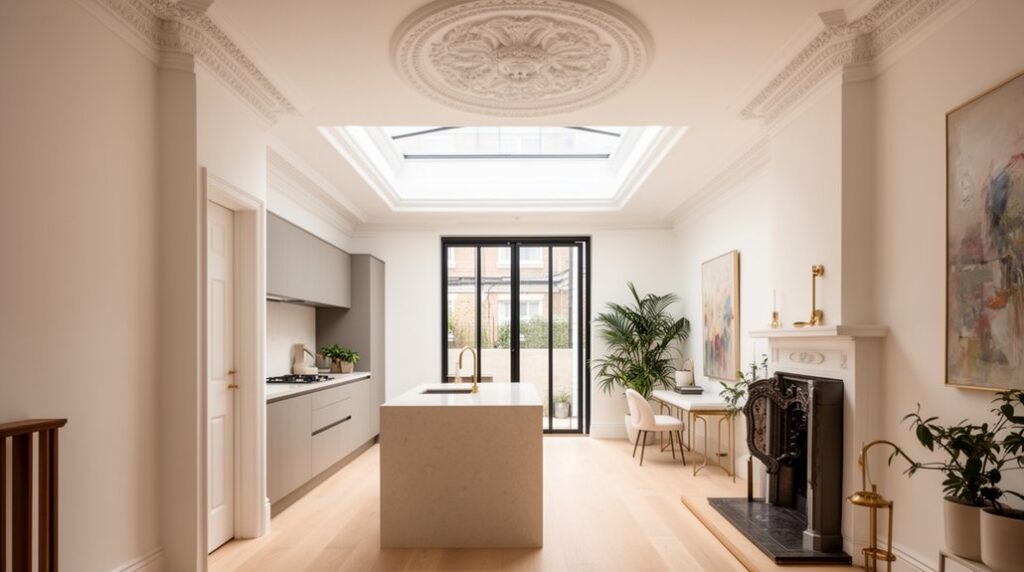

You’re starting with a house built for smaller rooms and lower light, so you’ll need a plan that respects what’s worth keeping while fixing what no longer works. You’ll survey cornice profiles, sash details, and chimney breast proportions before you touch plaster or joinery. You’ll also test for damp and decide where breathable insulation belongs. Then you’ll choose where to open up, where to glaze, and where to keep the Victorian rhythm—because the next decision can’t be reversed easily.
Plan Your Victorian Terrace Renovation
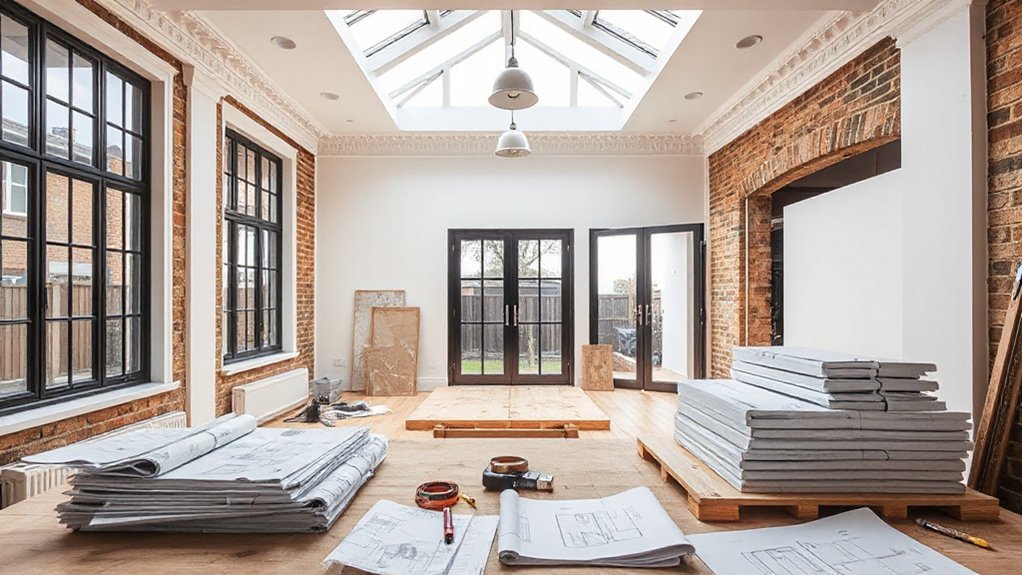
Where do you start when you’re turning a Victorian terrace into a bright, modern home without erasing its character? You begin with a measured survey: check floor levels, wall thicknesses, chimney breasts, and roof structure, then map services routes.
Log original fabric—sash windows, cornices, encaustic tiles, stair balusters—so you can retain, repair, or replicate profiles accurately.
Set daylight goals room by room, but respect the typical narrow plan of Victorian architecture; target borrowed light, glazed internal partitions, and carefully sized openings that don’t disrupt load paths.
Specify breathable materials for solid walls: lime plaster, vapour-open paints, and insulated linings with hygrothermal calculations.
You’ll keep historical preservation credible by matching joinery details and avoiding incompatible cement.
Check Permissions, Party Wall, and Constraints Early
Before you finalise layouts or order steel, you’ll confirm whether your rear extension, loft conversion, or new rooflights sit within permitted development or require full planning permission, especially if the terrace is in a conservation area.
You’ll also check constraints early—party wall status, shared chimney breasts, and boundary conditions—so your structural strategy matches what you’re legally allowed to build.
If work affects a party wall or foundations near a neighbour’s, you’ll serve Party Wall Act notices in good time and factor in surveyor appointments before you start on site.
Planning Permission And Permitted Development
Although many Victorian terrace upgrades fall under permitted development, you’ll save time and avoid enforcement headaches by checking permissions and constraints at the outset. Confirm whether your property sits in a conservation area, is locally listed, or carries an Article 4 Direction, as these can remove PD rights and tighten controls on rear extensions, rooflights, and dormers.
Review the original frontage rhythm—brick bonds, window proportions, parapet lines—so your drawings support Historic preservation rather than dilute it.
Seek a Lawful Development Certificate for PD works; it’s inexpensive evidence for lenders and future buyers. For consented schemes, submit measured surveys, heritage statements where required, and precise materials schedules (brick match, pointing profile, slate type).
Track conditions, discharge requirements, and building-control interfaces to maintain legal compliance.
Party Wall Notices Early
With permissions and any heritage constraints mapped, line up your Party Wall matters early, because Victorian terraces share structural fabric and your works often touch it. If you’re cutting into the party wall for steel beams, raising chimney breasts, underpinning, or excavating near a neighbour’s foundations, you’ll likely trigger the Party Wall etc. Act 1996.
Serve party wall notices with correct descriptions, drawings, and start dates, then allow statutory response periods before you programme demolition.
Prioritise early communication: walk neighbours through vibration, dust control, and temporary support, and offer a schedule of condition survey so pre-existing cracks in lime plaster or sash reveals are recorded.
If consent isn’t given, appoint surveyors promptly and agree an Award covering methods, access, and monitoring.
Restore Cornices, Fireplaces, and Original Joinery
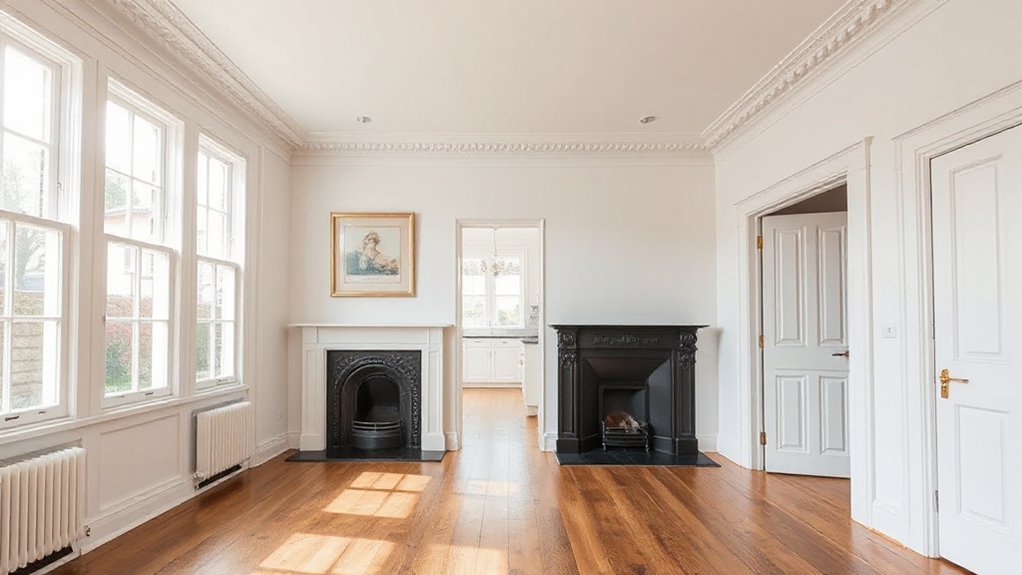
Once you’ve opened up the structure and planned the new layout, turn your attention to the Victorian fabric that gives the terrace its identity: cornices, fireplaces, and original joinery.
Start by mapping profiles room by room; take silicone molds of intact cornice runs, then splice missing sections with lime plaster in matching enrichment and projection. Consolidate friable edges with a compatible acrylic-free stabiliser, and avoid hard gypsum repairs that can telegraph cracks.
For fireplaces, retain original surrounds and tiles where possible; lift carefully, clean with non-ionic detergent, and rebed on lime mortar. Check hearth construction and flue integrity before reinstating a period-appropriate insert.
Strip paint from skirtings, architraves, and panelled doors with low-heat or solvent gels, then repair with dutchman splices and hide glue—Restoring cornices, fireplaces, and original joinery, preserving Victorian charm.
Open Up a Victorian Terrace (Structure and Flow)
When you open up a Victorian terrace, you can’t treat internal walls as disposable—confirm which are load-bearing and replace them with properly sized steelwork and padstones so the original floor structure stays stable.
You’ll also want to align rear extension openings to maintain clear sightlines from the front hall through to the garden, keeping the plan legible rather than chopped up.
To stop the centre of the house from going gloomy, you can rework the stairwell as a light well with roof glazing or high-level glazing while protecting the proportions of the original stair and landings.
Removing Load-Bearing Walls
Although Victorian terraces often feel compartmentalised by their original cellular plan, you can only open them up safely by treating every “solid” wall as suspect until proven otherwise.
Start by lifting floorboards and checking joist direction, bearing ends, chimney-breast nibs, and any thickened masonry that supports party walls.
For load bearing removal, you’ll need an engineer’s calculations, a temporary propping scheme, and a clear sequence of works.
Insert needles or strongboys, then install the specified steel beam or flitch with proper padstones, end bearings, and fire protection.
Don’t ignore lateral restraint: strap floors back to masonry and tie new steel into existing structure.
Good structural reinforcement also means controlling vibration, trimming joists neatly, and keeping original skirtings and cornices intact.
Rear Extension Sightlines
Because a Victorian terrace reads as a long, narrow tube, your rear extension has to manage sightlines as carefully as it manages structure, or the new space will feel tacked on. Set a primary axis from the original hallway or front room through the new opening to the garden, then keep that line clear with a centered aperture and consistent floor levels.
Use a steel goalpost frame to slim down supports and widen the visual span without overloading party walls. Align new glazing mullions with existing window proportions so the extension respects period rhythm.
Control rear extension sightlines by offsetting tall joinery and placing doors where you don’t clip views. Tie garden landscaping to the axis with a straight path, not fussy planting.
Stairwell Light Strategies
Since the stairwell usually sits at the darkest point of a Victorian terrace, you’ll get the biggest payoff by treating it as a light chimney, not just a circulation core. Start by reinstating or enlarging the rooflight over the stair, sized between rafters, with a thermally broken kerb and low‑iron glass to pull daylight deep without glare.
Then manage bounce: paint the stair walls in a high-LRV mineral matt, keep original timber handrails, and strip back heavy linings that swallow light.
For staircase lighting, run a concealed LED strip under the handrail or along the stringer, 2700–3000K, dimmable, with 90+ CRI for period materials. Add a flush ceiling downlight at landings for code-compliant uniformity, and layer ambient illumination via a discreet wall sconce at mid-flight.
Bring Daylight Into a Dark Victorian Terrace
When you step into a typical Victorian terrace, the plan form often funnels light to the front bay and rear yard while leaving the deep central zone—hall, stair, and former scullery—permanently dim. To rebalance it, you can open the internal plan selectively, not indiscriminately.
Replace a solid door with glazed joinery, or add a high-level internal window over a partition so daylight borrows through without erasing privacy.
Strip back later accretions that block the original fanlight, and reinstate slim glazing bars in keeping with Victorian architecture.
Use pale limewash or mineral paint on lath-and-plaster to lift reflectance, and choose matte finishes to avoid glare.
You’ll meet historical preservation by keeping original skirtings, architraves, and plaster cornices intact.
Rooflights and Rear Glazing: Detail, Privacy, Overheating
Although a rear extension and rooflights can transform a Victorian terrace’s gloom into clean, top-lit space, you’ll only get a comfortable result if you resolve the details early—set rooflights between joists with proper trimming and insulated upstands, specify low‑iron double glazing with warm-edge spacers, and align the new rear glazing with existing sill and cornice datums so the old and new read coherently.
Treat rooflights installation as a weathering exercise: maintain the roof pitch, lap flashings correctly, and keep internal reveals airtight to avoid condensation staining original plaster.
For privacy screening, angle fins or use acid-etched bands at eye level so you protect neighbours without dulling the room. Control overheating with solar-control coatings, external blinds, and opening lights set high for stack ventilation; size trickle vents to meet Part F without draughts.
Rework the Layout for Kitchens, Storage, and Utilities
Once the rooflights and rear glazing bring in daylight and tame glare, the next gain comes from reworking the plan so the kitchen, storage, and utilities sit where the house can actually service them.
You’ll typically keep the range and sink on the party wall to simplify duct runs and waste falls, then use the rear elevation for the dining run and tall units.
Set a clear kitchen layout: 1,000–1,100 mm aisles, uninterrupted worktop between hob and sink, and a concealed recycling pull-out.
You’ll hide the boiler, meters, and laundry in a full-height cupboard off the side return, with acoustic lining and access panels.
Build storage solutions into chimney-breast alcoves, but keep original trims and skirtings readable.
Insulation and Damp Fixes for Victorian Terraces
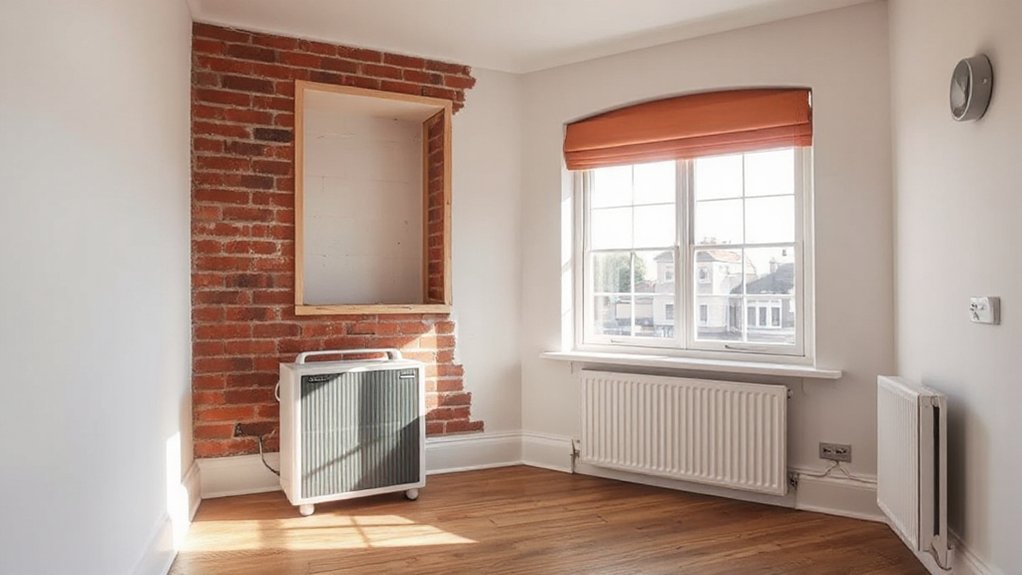
You’ll get the best results in a Victorian terrace if you insulate without trapping moisture, so you should favour breathable wall insulation systems that suit solid masonry and lime-based finishes.
You’ll also need to confirm whether damp is genuinely rising (failed DPC, bridged external ground levels, or salts) and apply targeted treatments rather than blanket tanking.
Then you can lock in comfort with floor and roof upgrades—tighten the joisted suspended floor with draught control and insulation, and add loft insulation with proper ventilation paths to prevent interstitial condensation.
Breathable Wall Insulation
Because most Victorian terraces rely on solid brickwork that manages moisture by absorbing and releasing it, your insulation strategy needs to stay vapour-open rather than trap damp behind an impermeable layer.
Choose breathable wall insulation such as wood fibre boards, cork, or hemp-lime with a lime-based adhesive and finish, so the wall can dry to both sides.
Avoid gypsum plasters, foil-backed boards, and cement renders that block vapour and concentrate salts.
Detail the junctions: return insulation into window reveals, keep skirtings off cold masonry, and maintain a continuous airtight but vapour-open layer with tapes designed for hygroscopic substrates.
Support it with natural ventilation—restored sash trickle vents, working chimneys with vents, and humidity-controlled extract in kitchens and baths—so internal moisture doesn’t overload the fabric.
Rising Damp Treatments
Although surveyors still reach for the catch‑all label “rising damp,” a Victorian terrace usually needs a more specific diagnosis before you add insulation or seal finishes at ground level.
Start by checking external ground levels, leaking gutters, bridged air bricks, and cement pointing that traps moisture in soft brick. Map salts and moisture with carbide or gravimetric tests, not just a surface meter.
If the original slate DPC is missing or bridged, you can specify damp proofing via a chemical DPC, but only after you lower ground and reinstate ventilation paths.
Internally, strip impermeable gypsum and vinyl paints, then replaster in lime with a sacrificial salt‑resistant base.
Add moisture barriers only where you can guarantee drying routes, and detail skirtings to avoid capillary bridges.
Floor And Roof Upgrades
Where do Victorian terraces quietly lose the most heat while storing up the most moisture risk? Under the suspended timber ground floor and through the uninsulated roof void.
Lift boards carefully, number them, and fit mineral wool or wood-fibre between joists on netting, leaving a ventilated void and clearing air bricks. Add a vapour-open membrane above insulation if you’re tightening draughts, and repair split joist ends before refitting.
Up top, keep the slate roof breathable: insulate at rafter level with a vapour-permeable underlay, or at ceiling level with quilt, but don’t block eaves ventilation. Seal chimney penetrations, fit loft hatch draught strips, and maintain lead flashings.
You’ll preserve Victorian charm while gaining modern functionality.
Heating and Ventilation for Victorian Terraces
While you’re chasing a warmer, brighter Victorian terrace, you can’t treat heating and ventilation as separate jobs—the original fabric was built to “breathe,” and modern upgrades can accidentally trap moisture.
Start by mapping draught paths, chimneys, and suspended floors, then set a target air-change rate and humidity band.
For HVAC upgrades, choose low-temperature emitters (oversized radiators or underfloor on insulated zones) so a heat pump can run efficiently without scorching plaster.
Keep original chimneys vented or capped with breathable terminals to avoid condensation in flues.
Add demand-controlled Ventilation systems: continuous extract in kitchen/baths, trickle supply or MVHR where airtightness is proven, and dedicated combustion air for any open-flame appliance.
Commission with flow tests, not guesswork.
Modern Finishes That Suit Victorian Details
Once you’ve stabilised heat and moisture, you can choose modern finishes that sharpen a Victorian terrace’s proportions instead of fighting them. Keep original architraves, skirtings, and ceiling roses, then run crisp junctions with fine caulk lines and shadow gaps where new meets old.
Use lime-compatible paints on solid walls; choose matte, high-coverage acrylic on later plasterboard to avoid flashing.
For floors, restore boards and seal with a hardwax oil for a low-sheen look that still reads as Victorian craftsmanship.
In kitchens and bathrooms, specify slim-profile cabinetry, honed stone, and simple pulls so cornices stay dominant.
Use heritage greens, off-whites, and soft charcoals to support period authenticity, and match switch plates in aged brass or painted metal, not glossy plastic.
Frequently Asked Questions
How Much Does Renovating a Victorian Terrace Typically Cost per Square Metre?
You’ll typically pay £1,500–£3,500 per m² in the UK; allow £4,000+ per m² for structural, heritage, or high-spec work. Use cost estimation and renovation budgeting to reflect surveys, MEP, contingencies.
How Long Does a Full Victorian Terrace Renovation Usually Take?
You’ll usually need 6–12 months for a full renovation, or 3–18 months with structural work and consents. You’ll manage Victorian architecture carefully, sequencing surveys, services, and historical preservation details before finishes.
Should I Live in the House During Renovation or Move Out?
Move out if you can—about 70% of major remodels run over schedule, so disrupted living arrangements often worsen stress and slow the renovation timeline. If you stay, isolate work zones, maintain safe egress, and control dust.
How Do I Choose a Builder Experienced With Victorian Terrace Renovations?
Choose a builder by checking proven Victorian-terrace case studies, verifying references, and reviewing method statements. You’ll prioritise Historical preservation credentials, confirm structural and damp expertise, and guarantee they can integrate Modern design details.
What Insurance Do I Need Before Starting Major Renovation Work?
Before you start, get Buildings insurance with renovation coverage, plus contractor’s all-risks and public liability; they’re your safety net. Confirm Insurance requirements with your lender, notify insurers pre-works, and document values, dates, and exclusions.
Conclusion
When you renovate a Victorian terrace well, you’re not stripping history—you’re tuning it like a fine instrument. You’ve checked consents and Party Wall notices, repaired cornices and sash cords, and opened structure only where steels and padstones make it safe. Rooflights and internal glazing pour daylight down the plan like a ribbon. Breathable lime, sensible insulation, and controlled ventilation keep damp at bay. Then modern services slip in quietly, and the house finally breathes.