
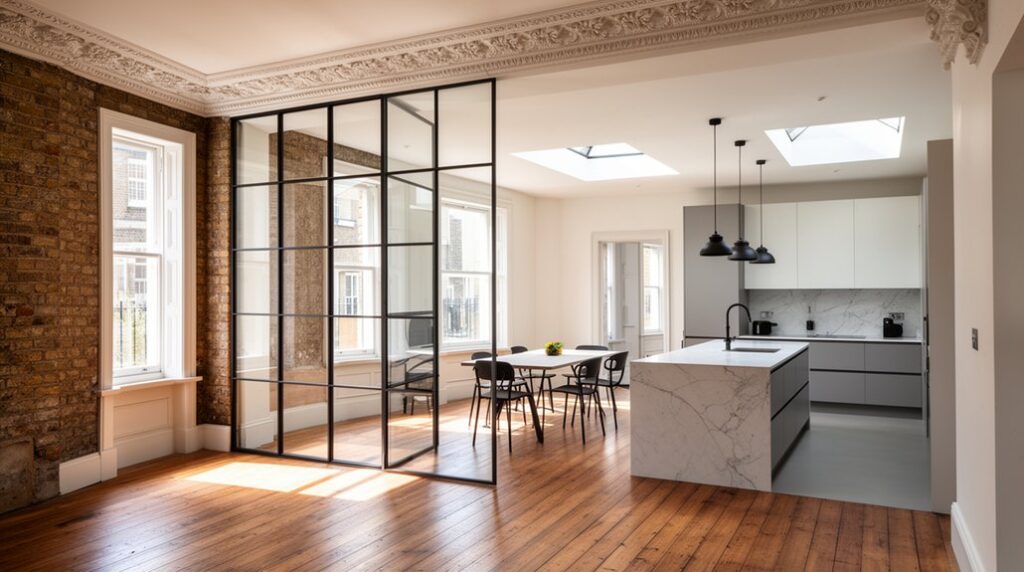

You can open up a period home, but you can’t start by swinging a sledgehammer. You’ll first map chimney breasts, joist directions, and load paths, then check whether listing, conservation rules, or Building Control will limit what you change. Plan the layout around cornices, sash proportions, and fireplace locations, and hide new steel and services so the original rooms still “make sense.” The next decision will determine everything…
Can Your Period Home Go Open‑Plan? Key Checks
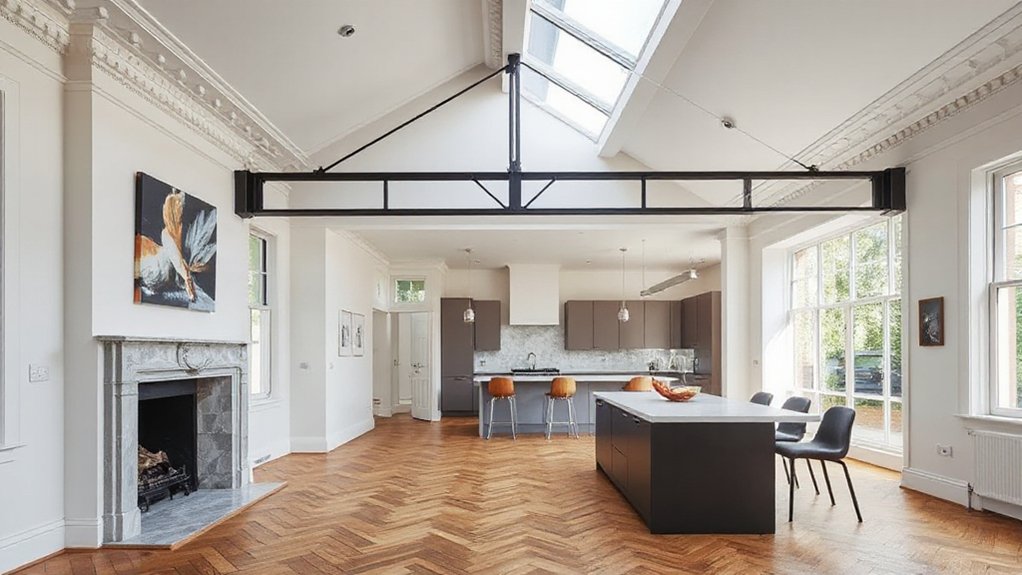
Before you start knocking through walls, you’ll need to confirm how your period house actually works—structurally, legally, and practically—because Victorian terraces, Georgian townhouses, and Edwardian semis often rely on load‑bearing masonry, chimney breasts, and floor joists that weren’t designed for today’s open spans.
Start by mapping which walls carry floors or roofs, and trace how chimney stacks, trimmers, and nibs stiffen the plan. Check floor direction and deflection; long, shallow joists may need strengthening before you widen openings.
Locate damp, lath-and-plaster, and historic cornices so you can protect them. For Historical accuracy, keep key thresholds—like a retained chimney breast or arch—then use glazing, wider doorways, and aligned sightlines to achieve flow while preserving interior decor.
Check Permissions (Listed, Conservation, Building Control)
Although an open‑plan remodel can look like a simple knock‑through, permissions often decide what you can actually alter in a period house, so check your status early and design to it.
First confirm whether you’re in a conservation area or the building is listed; both bring heritage restrictions that can cover internal walls, stair enclosures, fireplaces, and even window reveals. Speak to the local conservation officer before you finalise drawings, and document existing fabric with measured sketches and photos.
If you need planning permissions, submit clear heritage statements showing what stays, what changes, and why it’s reversible. Separately, Building Control will assess structure, fire separation, escape routes, ventilation, and insulation upgrades.
Agree the approval route—full plans or building notice—so sequencing and costs don’t drift.
Plan an Open‑Plan Layout Around Original Features
Once you’ve mapped what can and can’t move, plan the open‑plan zone as a series of “rooms” anchored by the house’s original cues—chimney breasts, ceiling roses, stair hall geometry, deep skirtings, and window bays—so the new layout still reads as period.
Set the dining table under the rose, align the sitting area to face the hearth, and use the bay as a reading nook.
Keep circulation on the old axis from hall to garden, and let door openings frame key views.
Run joinery and shelving between existing piers to avoid orphaned corners.
Reinstate or echo Decorative moldings to mark transitions, and choose Vintage fixtures—pendants, switches, and radiators—to keep the scale and patina believable.
Match plank direction to sightlines.
Work Out Which Walls You Can Remove Safely
Before you open up a period plan, you’ve got to map which walls are doing the real work—often the thick masonry party wall, chimney breast returns, or a spine wall carrying joists from front to back.
You can’t guess: trace joist directions in the ceiling void, check beam pockets, and confirm what’s load‑bearing before any demolition starts.
Once you know what must stay, you’ll plan structural supports—steel beams, posts, or trimmed openings—so the new open‑plan room reads seamless while the house stays sound.
Identify Load-Bearing Walls
Where do you start when you’re eyeing up a wall in a period house and imagining open plan? Begin by reading the building’s logic: in Georgian and Victorian homes, spine walls often run front to back, carrying joists that span to external walls. Lift a floorboard edge or check the ceiling direction; if joists land on the wall, treat it as load‑bearing.
In basements and lofts, look for stacked walls that align room to room, and note chimney breasts tied to period fireplaces, which can anchor structure. Don’t let decorative moldings fool you; fine cornices often cross non‑structural partitions too.
Tap for solidity, measure thickness, and trace where doors and openings repeat between floors. Document everything before decisions.
Plan Structural Supports
How far can you open up a Georgian or Victorian plan without compromising its bones? Once you’ve mapped load paths, you’ll plan supports before you touch plaster.
Assume party walls, chimney breasts, and spine walls carry joists; if you remove sections, you must replace their work with steel, engineered timber, or discreet posts. Set beam depths to clear cornices and ceiling roses, and align new columns with existing door reveals so circulation still reads period-correct.
You’ll coordinate padstones, bearings, and lateral restraint to stop spread at floor edges, especially where sash-window openings weaken masonry. Hide structure in bulkheads that echo original Decorative motifs, then tune Interior color schemes to visually stitch old rooms into one open suite.
Choose Discreet Structural Support (RSJ, Posts, Flush Beams)
Although you’re opening up rooms that were originally meant to be enclosed, you can still keep the structure reading as “period” by specifying discreet support from the outset—typically an RSJ sized by an engineer, a slim post aligned with existing wall lines, or a flush beam concealed within the floor or ceiling build-up.
Set supports where they make spatial sense: on chimney-breast returns, along former partition lines, or within joinery runs, so the new span feels inevitable.
If you want Decorative beams, treat them as a finish layer, not the structure; pair them with Hidden supports so proportions stay believable.
Keep soffits tight, align downstands with cornice breaks, and coordinate bearing points with skirtings and door heads.
You’ll gain openness without losing historic rhythm.
Add Natural Light (Rooflights, Glazing, Borrowed Light)
Often, the quickest way to make an open-plan rework feel intentional in a period house is to pull daylight deep into the plan, not just widen openings. Start with Skylight placement: align rooflights with the former bay line or along the new circulation spine so the brightest patch lands where you walk and work, not on cabinet tops. Keep sight of original roof proportions; use slim kerbs and sit frames between rafters to avoid a clumsy “cut-in” look.
Next, choose Glazing options that respect historic rhythms. Use tall, narrow panes in steel-look or timber sections, and set transoms to echo existing sash meeting rails.
For borrowed light, add reeded or clear internal screens above doors, or a glazed fanlight, to share daylight while preserving acoustic separation.
Create Zones Without Blocking Open‑Plan Sightlines
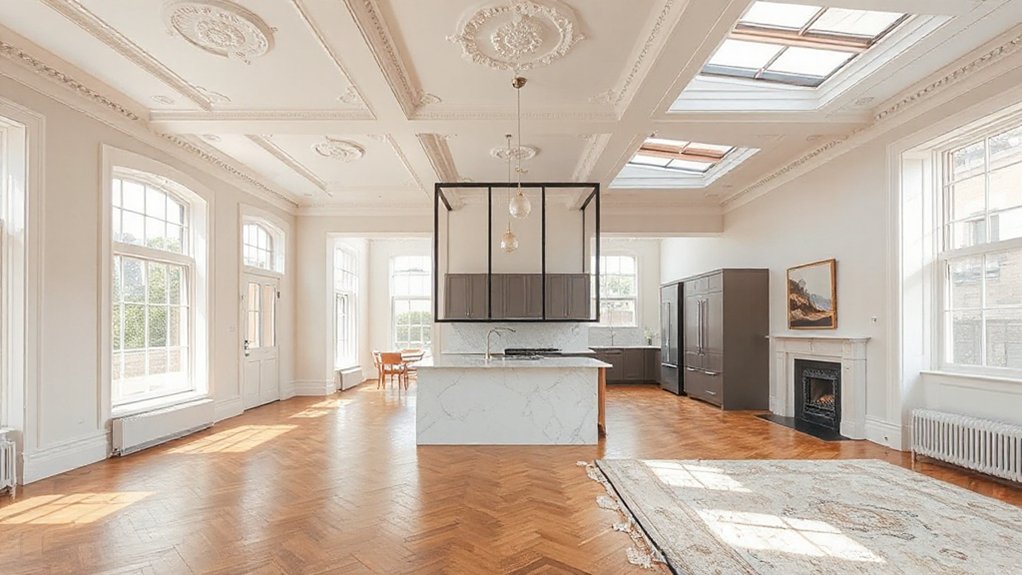
When you open up a period plan, you still need clear “rooms” for dining, cooking, and living, or the space reads as a corridor with furniture. Use the house’s original cues—chimney breast, bay, ceiling beam line, or stair hall—to set zone edges without adding walls.
Start with Furniture placement: float the sofa with a slim console behind it, align the dining table to a bay or fireplace axis, and keep a continuous circulation strip along the old passage line.
Layer in low-height dividers such as open bookcases, screens, or a change in rug size to mark thresholds while preserving views.
For Acoustic zoning, add thick rugs, upholstered dining chairs, and heavy-lined curtains so conversation stays local, even as sightlines stay open.
Blend Finishes + Upgrade Services for Modern Comfort
If you treat the old shell as a backdrop rather than a theme, you can blend period finishes with modern insertions so the new open plan feels deliberate. Keep original cornices, architraves, and skirting crisp, then pair them with modern finishes like flush cabinetry, slim shadow gaps, and large-format stone or microcement floors that read as calm planes.
Upgrade services early so comfort doesn’t fight heritage: reroute plumbing in service walls, run electrics in floor voids, and position extract ducts along joist bays to protect ceilings.
Specify underfloor heating where levels allow, or low-profile radiators aligned to window bays. Add acoustic insulation between old joists, and use discreet air-supply grilles above joinery.
You’ll preserve period detail while meeting modern expectations.
Frequently Asked Questions
How Do I Manage Renovation Dust and Noise While Living in the House?
Set up sealed poly-sheet partitions, run HEPA air scrubbers, and stage work room-by-room for dust mitigation. Schedule loud trades daytime, add door seals, and use rugs and curtains for noise control, protecting historic finishes.
What’s a Realistic Timeline for an Open‑Plan Period Home Renovation?
You’re looking at 4–8 months, depending on structural walls, Design aesthetics approvals, and Material selection lead times. Expect 4–8 weeks design/consents, 8–16 weeks construction, plus 2–4 weeks finishes, joinery, and commissioning.
How Can I Protect and Store Antiques and Original Furniture During Work?
Sure, let dust “polish” them—then you’ll regret it: photograph, inventory, wrap with acid‑free tissue and padded covers for Antique preservation and Furniture protection, label by room, palletize, and store off‑site in climate control.
Will Open‑Plan Changes Affect My Home Insurance or Future Premiums?
Yes, they can: you’ll face insurance implications and premium considerations when you remove walls, rewire, or relocate kitchens. You should notify your insurer, document permits, and keep fire‑separation, joist support, and escape routes compliant.
How Do I Maintain Privacy and Acoustics in an Open‑Plan Family Home?
You’ll tame sound and sightlines like drawing velvet curtains in a great hall: zone rooms with bookcases, screens, and doors as privacy solutions, then layer rugs, drapes, and baffles as acoustic treatments.
Conclusion
When you open up a period home, you’re not erasing history—you’re editing it with a steadier hand. Think of it like the 1890s terrace owner who braced a chimney breast with a new steel lintel: one hidden beam, and the whole room breathed again. You’ll do the same—check consents, map load paths, and choose discreet supports—then pull daylight through rooflights and glazing. Zone with furniture, not walls, and tuck services in neatly.