
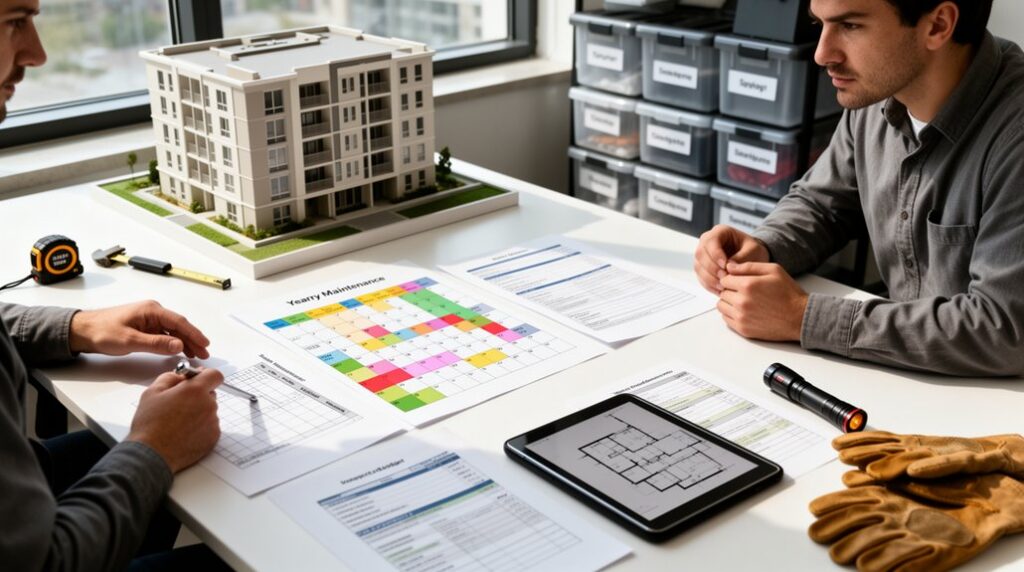

Like a seasoned facilities manager walking a site with a clipboard, you start by defining what your maintenance plan must achieve: safety, legal compliance, uptime, and asset value protection. You inventory every system and component, then rank tasks by risk, cost, and consequence. You set clear standards, response targets, and documented procedures, and you lock in a preventive schedule that fits your climate and occupancy. Next, you’ll see how to make it hold up under real-world pressure…
Define What Your Maintenance Plan Must Achieve

Before you schedule inspections or hire vendors, you need to define exactly what your maintenance plan must achieve: protect occupant safety, preserve asset value, meet legal and insurance obligations, and keep building systems performing as designed.
Translate these outcomes into measurable requirements: target response times for life-safety issues, acceptable downtime limits for critical equipment, and documented code-compliance checkpoints.
Align responsibilities so nothing falls between roles, and require auditable records for permits, tests, and corrective actions.
Build Maintenance budgeting around risk and lifecycle priorities, not habits, and set thresholds for when repairs become replacements.
Close gaps with staff training tied to SOPs, lockout/tagout, chemical handling, and incident reporting.
When you define success upfront, you’ll control cost, reduce exposure, and improve reliability.
Build a Full Property Asset List Fast
How do you build a complete property asset list fast without missing high-risk equipment? Start with a structured property inspection using a room-by-room and rooftop-to-basement route, then capture every asset’s make, model, serial number, location, capacity, and install date.
Photograph data plates and log utility shutoffs, panels, backflow devices, alarms, elevators, boilers, HVAC units, pumps, and fire extinguishers. Pull permits, warranties, O&M manuals, and prior service tickets to validate what you saw and to close gaps.
Standardize names and tags so contractors and staff record updates consistently. Use tenant communication to confirm in-suite equipment, access constraints, and after-hours entry rules, and document who must be notified.
Store everything in a single CMMS or spreadsheet with audit-ready fields.
Prioritize Maintenance Tasks by Risk and Cost
Once you’ve built a clean asset list, you can rank what to maintain first instead of treating every work order the same. Start with a quick Risk assessment for each asset: probability of failure, impact on safety and operations, and downtime consequences. Assign a simple score (1–5) for likelihood and severity, then multiply to create a priority index you can defend.
Next, tie the index to Maintenance budgeting. Estimate labor hours, parts lead times, contractor rates, and access needs, then compare cost-to-fix now versus cost-to-fail later. Schedule high-risk, low-cost tasks immediately to prevent cascading damage.
Bundle similar tasks by location and trade to reduce mobilization costs. Revisit priorities monthly using work order history, repeat failures, and updated condition notes to keep spend aligned with risk.
Set Property Maintenance Standards and Compliance Rules
Even if your task list is perfectly prioritized, you still need clear maintenance standards and compliance rules to define what “good” looks like and to prove you met it.
Start by documenting Property standards for each system: life-safety, HVAC, electrical, plumbing, fire protection, exterior, and common areas. Specify measurable thresholds (e.g., illumination levels, water temperature ranges, door-closing force, trip-hazard height) and acceptable materials, workmanship, and tolerances.
Map each standard to applicable compliance regulations, permits, and inspection requirements, including local code, ADA, OSHA, and insurance conditions.
Assign responsibility: who approves repairs, who can sign off, and who escalates deficiencies.
Require evidence: checklists, photos, test results, certificates, and vendor invoices.
Set audit rules and retention periods so you can defend decisions quickly.
Create a Preventive Maintenance Schedule That Sticks
You can’t rely on ad-hoc work orders—build a preventive maintenance schedule that targets your highest-risk assets first (life safety systems, critical HVAC, electrical panels) to reduce failures and compliance exposure.
Set clear recurring cadences by asset type and manufacturer requirements (weekly inspections, monthly tests, quarterly servicing, annual certifications) so nothing slips.
Then assign owners, due dates, and documented completion standards to keep audits clean and uptime high.
Prioritize High-Risk Assets
Where do you start when every system seems “important”? You start with risk. Rank assets by failure impact, regulatory exposure, and criticality to operations. Use asset valuation to compare replacement cost, downtime losses, and liability severity.
Then map each asset to codes, warranty terms, and inspection requirements so you don’t miss mandated actions. Focus first on life-safety and business-continuity systems: fire alarms, suppression, elevators, boilers, emergency lighting, electrical switchgear, and roofing penetrations.
Verify safety protocols for lockout/tagout, confined space, and hot work before any task begins. Document condition, defects, and corrective actions with photos, test results, and sign-offs.
When you prioritize this way, you cut incidents, avoid citations, and protect uptime and budgets.
Set Recurring Task Cadences
Once you’ve ranked assets by risk, lock in recurring task cadences so inspections and service happen on time, every time. Set frequencies by OEM guidance, code requirements, warranty terms, and condition data, then document them in your CMMS.
Build calendars that cover daily rounds, weekly safety checks, monthly lubrication, quarterly testing, and annual certifications, with escalation rules for missed work orders.
Standardize Scheduling inspections with checklists, photos, and pass/fail criteria so audits stay clean and defects don’t slip through. Assign clear owners, backups, and estimated labor hours to prevent schedule drift.
Tie cadence adherence to KPI targets like completion rate, downtime, and repeat failures. Reinforce execution through Staff training on procedures, lockout/tagout, and reporting, so tasks close correctly and on time.
Add Seasonal Property Maintenance Checklists by Climate
You’ll tighten your Property Maintenance Plan by adding seasonal checklists that match your climate, so inspections and repairs stay compliant and audit-ready.
You’ll define a cold-climate checklist that prioritizes freeze protection, roof and gutter integrity, and safe access.
Then, set a temperate-climate checklist that targets drainage, exterior envelope condition, and HVAC tune-ups.
You’ll also implement a hot-humid checklist that controls moisture, mold risk, pest pressure, and cooling-system performance to prevent failures and reduce lifecycle costs.
Cold Climate Seasonal Checklist
How well your property performs through freeze–thaw cycles depends on what you inspect and document before temperatures drop. Schedule roof and flashing checks, clear gutters, and verify drainage slopes away from foundations to limit ice dams and seepage. Seal exterior cracks, confirm weatherstripping, and test door closers to protect Energy efficiency metrics.
Service boilers/furnaces, replace filters, calibrate thermostats, and verify carbon monoxide detectors meet code and inspection logs. Insulate exposed piping, heat-trace vulnerable runs, and locate shutoffs; then post emergency procedures for staff.
Confirm snow-removal contracts, mark hydrants and walkways, stock de-icer, and document slip-hazard controls for liability. Improve Tenant communication with pre-winter notices covering heating setpoints, window use, reporting leaks, and after-hours response expectations.
Temperate Climate Seasonal Checklist
Because temperate regions swing between wet winters, mild freezes, and hot, humid summers, you need a season-by-season checklist that targets moisture control, drainage performance, and HVAC changeovers without over-investing in deep-freeze mitigation.
In spring, clear roof valleys and gutters, camera-scan drains, test sump pumps, and document exterior sealant repairs for warranty and code files. Service heat pumps, replace filters, and verify thermostat staging.
In summer, inspect irrigation coverage, prevent overspray on siding, and schedule landscaping enhancements that improve grading away from foundations; log pesticide use per local regulations.
In fall, flush downspouts, check window flashing, tune furnaces, and confirm CO alarms meet replacement dates.
In winter, monitor attic ventilation, spot-check condensate lines, and prioritize slip-resistance treatments plus exterior lighting aesthetic upgrades.
Hot Humid Climate Checklist
Where do hot, humid climates hit a property first—at the moisture line, where heat, wind-driven rain, and salt air (in coastal zones) turn small leaks into mold, rot, and corrosion fast.
Start spring by clearing roof drains, sealing penetrations, and documenting repairs for warranty and code files.
Summer: verify humidity control by calibrating thermostats, confirming 45–55% RH, and servicing dehumidifiers and condensate lines.
Inspect attic, crawlspace, and bath exhaust for backdrafting; upgrade ventilation strategies with balanced airflow and outdoor-air dampers as required.
Quarterly, treat algae on siding, check caulk at windows/doors, and test GFCIs and surge protection.
Before storms, secure loose flashing, clean gutters, and stage tarps, pumps, and photos for claims.
Record readings and close tickets.
Budget Your Property Maintenance Plan Realistically
Before you schedule a single service call, set a realistic maintenance budget that matches your property’s size, age, usage, and regulatory obligations. Start with a baseline: last 24 months of spend, asset inventory, warranty status, and any code-mandated inspections.
Separate fixed compliance costs from variable condition-based work so you don’t raid safety funds to cover cosmetic repairs.
Build line items for HVAC, roofing, plumbing, life-safety systems, pest control, and documentation, then add a contingency (5–15%) for failures.
Use lifecycle costing to time replacements before breakdowns, driving Cost reduction without cutting required scope.
Fund Staff training on inspection checklists, permit logs, and incident reporting to prevent repeat defects and audit findings.
Track monthly variance and adjust promptly.
Assign Roles, Vendors, and Response Time Targets
How fast should a leaking pipe, a failed fire panel, or a broken exterior light get resolved on your property? Set response time targets by risk: life-safety alarms get immediate dispatch, active leaks get same-day containment, and lighting defects get fixed within defined business-hour windows.
Document these targets as Response metrics, then assign accountability by trade and location so there’s no handoff confusion.
Define who triages calls, who approves spend, and who verifies completion against code, lease, and insurer requirements.
Build a primary and backup roster for HVAC, plumbing, electrical, fire/life safety, and grounds.
For Vendor selection, prequalify licensing, certifications, insurance, after-hours coverage, parts access, and SLA acceptance.
Require escalation steps, communication expectations, and final closeout documentation standards.
Choose Tools to Track Maintenance and Work Orders
When should you rely on spreadsheets, and when do you need a dedicated CMMS or work order platform? Use spreadsheets when you manage a small site, low ticket volume, and limited compliance documentation.
Switch to purpose-built digital tools when you must control preventive maintenance schedules, asset histories, warranties, and inspection records across multiple locations.
Select tracking systems that enforce required fields (location, asset ID, priority, safety notes), timestamp every status change, and preserve attachments for audits.
You should also require role-based access, vendor portals, mobile offline mode, and automatic escalation aligned to your response-time targets.
Integrate the platform with email, accounting, and inventory so parts, labor, and invoices match each work order.
Finally, confirm it supports exportable reports and data retention policies to meet regulatory and insurer requirements.
Measure Results and Improve Your Maintenance Plan Monthly
Even if your preventive schedules look solid on paper, you should review maintenance performance every month to prove compliance, catch drift, and reduce risk. Pull closed work orders, inspection logs, vendor invoices, and asset downtime reports, then validate them against policy and code requirements.
Track Maintenance metrics like PM completion rate, response time, repeat repairs, overtime hours, cost per asset, and safety incidents. Compare each metric to performance benchmarks you’ve set for critical systems (HVAC, life safety, elevators) and document variances.
Run a brief root-cause review on any missed PMs or recurring failures, assign corrective actions, and set due dates. Update task frequencies, checklists, and parts stocking based on findings.
Publish a monthly scorecard so stakeholders see trends and accountability quickly.
Frequently Asked Questions
How Do I Communicate Maintenance Plans to Tenants Without Causing Concern?
Communicate maintenance plans by sharing a clear schedule, explaining safety benefits, and inviting questions. Provide Tenant reassurance through Communication clarity, written notices, and documented access procedures. You’ll reduce anxiety, meet compliance requirements, and minimize disruptions.
What Insurance Policy Changes Are Recommended After Implementing a Maintenance Plan?
You’ll boost protection a thousandfold by requesting Policy updates: increase Insurance coverage limits, add equipment breakdown, adjust vacancy and liability endorsements, confirm ordinance-or-law and water backup. You’ll also document inspections and notify carriers to maintain compliance.
How Can I Handle Maintenance for Mixed-Use Properties With Different Operating Hours?
Handle mixed-use maintenance by separating zones and aligning Maintenance scheduling to each operating window. Use Tenant coordination for after-hours access, permits, noise limits, and safety checks. Track SLAs, document inspections, and verify compliance.
When Should I Hire an In-House Technician Versus Relying on Contractors?
You hire in-house when calls stay frequent, response must be immediate, and compliance logs demand control. Like a lighthouse keeper, you run Technician evaluation; when work’s specialized, sporadic, or risky, prioritize Contractor selection and SLAs.
How Do I Manage Maintenance Responsibilities Across Multiple Property Owners or HOAS?
You manage responsibilities by drafting clear HOA/owner scopes, approval thresholds, and SLAs, then centralize Maintenance scheduling in one system. You drive Tenant engagement via reporting, document compliance, audit vendors, and enforce timelines.
Conclusion
You can run maintenance reactively and chase breakdowns, or you can run it professionally and prevent them. Define clear goals, document every asset, and rank tasks by risk, cost, and impact. Set standards that meet codes, safety rules, and lease obligations, then lock in a preventive schedule you’ll actually follow. Budget with real labor and vendor rates. Assign owners and response targets. Track work orders, review KPIs monthly, and keep improving.