
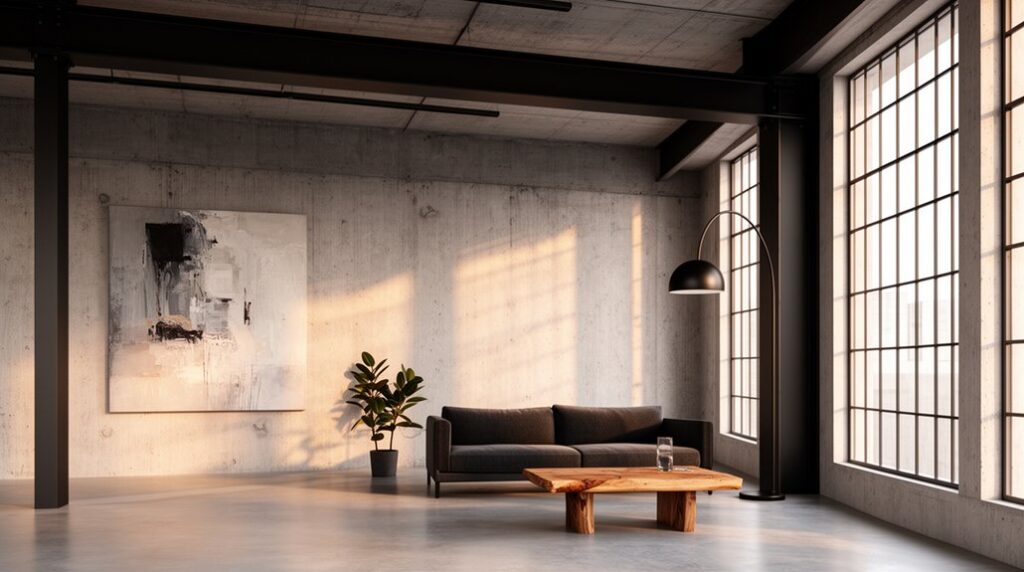

You pair raw concrete with quiet negative space, and the room feels both tougher and calmer. You start by mapping zones and circulation, then you hold back on finishes so brick, steel, and unfinished wood stay honest. You keep a restrained palette—matte blacks, warm greys, and one muted accent—so contrast doesn’t turn into noise. You choose furniture with clean, functional lines and layer diffused lighting to soften edges, but one detail can still break the balance…
5 Rules for Industrial Minimalism
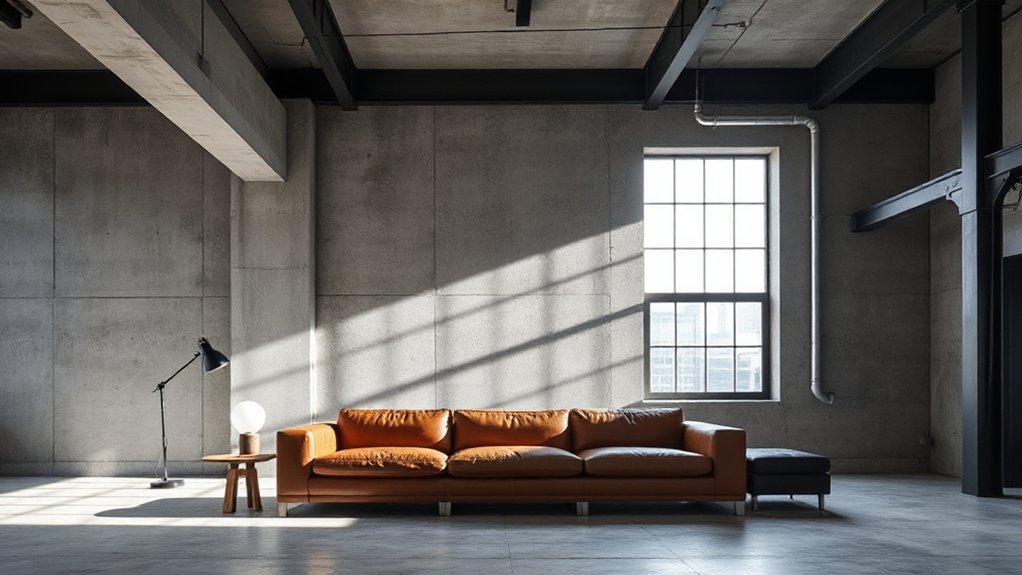
While industrial minimalism borrows the rawness of factories and the restraint of modern minimalism, it only works when you follow a few strict constraints: prioritize a limited material palette (steel, concrete, unfinished wood), keep forms geometrically simple, and let structure and function dictate what stays.
Rule 1: expose honest surfaces—don’t conceal welds, fasteners, or grain; just seal for durability.
Rule 2: control contrast with a tight tonal range, then specify one accent finish, like blackened steel.
Rule 3: choose Eco friendly materials—reclaimed timber, low-VOC sealers, recycled metal—so performance matches aesthetics.
Rule 4: limit fixtures to task-driven pieces; select industrial-rated hardware and diffused lighting.
Rule 5: use vintage decor sparingly—one patinated stool or factory clock—to add age without clutter.
Start With Layout: Zones, Flow, Negative Space
Control negative space deliberately. Leave at least one uninterrupted plane per zone (floor or wall) to keep visual load low and highlight structure.
Position tall pieces on perimeter lines so the center reads open.
Protect natural light by keeping window-adjacent areas sparse, using low profiles and avoiding high-backed blockers that create hard shadows.
Re-check circulation after every placement.
Choose Authentic Finishes (Brick, Concrete, Steel, Wood)
Once your zones read clean and the circulation paths stay unobstructed, lock in the material palette that makes minimalist industrial feel intentional. Prioritize Authentic finishes that reveal structure: expose brick where it’s sound, repoint joints, and seal to control dusting.
Specify concrete with a honed or matte finish; grind high spots, fill voids, then apply a penetrating densifier for durability without shine. Use steel deliberately—blackened plate, hot-rolled angles, or powder-coated tube—showing welds and fasteners rather than hiding them.
Introduce wood as honest millwork: solid or thick veneer, square edges, minimal profiles, and clear oil to keep grain legible. Keep Industrial textures consistent by repeating one or two surface treatments across major planes and built-ins to avoid visual noise.
Build a Restrained Palette (Warmth + Contrast)
You’ll get a cleaner industrial read by limiting the base palette to warm neutrals—sand, taupe, greige, and charcoal—so brick and wood register as controlled warmth.
You’ll sharpen the composition with cool metals like brushed steel, blackened iron, and anodized aluminum, keeping sheen levels consistent to avoid visual noise.
You’ll create contrast through material pairing—matte plaster against raw concrete, oiled oak against powder-coated steel—so texture, not color, carries the hierarchy.
Warm Neutrals, Cool Metals
While raw concrete, brick, and exposed ducts set the industrial baseline, a restrained palette depends on warm neutrals paired with cool metals to keep the space livable without diluting its edge.
Start with warm neutrals—bone, putty, sand, and greige—on large planes like walls, ceilings, and rugs to control reflectance and soften hard shadows. Keep undertones consistent; pick either yellow-based or pink-based neutrals so daylight and LEDs don’t shift the room muddy.
Then specify cool metals—brushed stainless, blackened steel, satin nickel, or anodized aluminum—for fixtures, hardware, and frames. Choose low-sheen finishes to reduce glare against concrete.
Repeat metal tones at measured intervals, and cap the palette at three neutrals plus two metals. Maintain crisp delineations with clean lines.
Contrast Through Material Pairing
A warm-neutral base and a tight metal mix set the temperature, but material pairing creates the contrast that keeps minimalist industrial rooms from reading flat.
You’ll get depth by stacking surfaces with different reflectance: matte plaster against sealed concrete, oiled oak against powder-coated steel. Specify one dominant warm material (wood or leather) and one cool counterpoint (steel or aluminum), then repeat them at 60/30/10 to keep the palette restrained.
Use metal texture deliberately—brushed for soft diffusion, blackened for edge definition, perforated for shadow play. Balance that opacity with glass transparency in cabinet fronts, partitions, or pendants so light penetrates heavy volumes.
Anchor the mix with a single stone or composite, honed not polished, for controlled sheen.
Pick Furniture With Clean, Functional Lines
You’ll get a sharper minimalist industrial read when you pick furniture built on simple geometric shapes—rectangular tops, square frames, and straight legs that align with the room’s grid.
Choose multiuse industrial pieces like a steel-and-wood console that functions as storage, display, and work surface, so every component carries load and purpose.
Keep profiles low and sleek with thin-gauge metal, flush joinery, and tight clearances that preserve sightlines and reduce visual mass.
Prioritize Simple Geometric Shapes
Because minimalist industrial spaces depend on structure more than ornament, prioritize simple geometric shapes to keep the room visually disciplined and function-first. Choose rectilinear sofas, slab coffee tables, and straight-leg chairs so edges align with beams, window mullions, and exposed piping.
Favor tight radii, flat planes, and consistent thicknesses to reduce visual noise and emphasize material junctions.
Keep silhouettes legible: cylinders for stools, cubes for storage, and low-profile benches with square tubing. Place geometric wall art in a grid to echo factory layout logic, and use sculptural lighting with linear or polyhedral frames to cast crisp, repeatable shadows.
Limit finishes to matte black, brushed steel, and warm wood so form reads first. When every piece resolves to clear geometry, circulation paths stay clean and the room feels engineered, not decorated.
Choose Multiuse Industrial Pieces
Two jobs per piece keeps a minimalist industrial room lean, so choose multiuse furniture with clean, functional lines and hardware-forward construction.
Start with a steel-and-oak worktable that doubles as dining, using bolted angle brackets and a sealed top that resists heat, spills, and abrasion.
Specify benches with lift-up seats for hidden storage, or a caster-base cabinet that shifts between media console and pantry.
Pick a sofa with a drop-down back or integrated side shelf to replace extra end tables.
Add wall-mounted pipe shelving that supports bins, books, and lighting, keeping load ratings and anchor points in mind.
Treat these as versatile decor: their exposed fasteners, weld seams, and matte finishes become the room’s detailing without adding clutter.
Keep Profiles Low And Sleek
When you keep furniture profiles low and sleek, the room reads larger and the industrial structure stays in focus instead of getting blocked by bulky silhouettes. Choose sofas with thin track arms, exposed steel legs, and tight upholstery; they maintain sightlines to brick, beams, and ductwork.
Specify tables with slab tops, squared edges, and minimal overhang, so circulation stays clear and proportions feel engineered.
Prioritize clean, functional lines: straight-backed chairs, open-frame shelving, and platform beds with recessed bases. Use matte black, oiled walnut, or concrete tones to reduce visual noise.
Anchor the layout with one controlled statement—industrial art in a slim metal frame—then layer restrained vintage decor like a patinated factory stool or a single enamel task lamp.
Keep hardware flush and seams crisp throughout.
Use Lighting to Soften the Hard Edges
Although exposed concrete, steel, and brick define minimalist industrial spaces, you can use lighting to reduce their visual severity without diluting the aesthetic. Build an ambient glow with layered sources: indirect cove LEDs to wash ceilings, wall grazers to reveal brick texture, and tight-beam spots to isolate key objects.
Prioritize fixture selection that stays visually quiet: slim linear pendants, matte-black cylinders, or recessed trims that align to grids. Specify 2700–3000K for warmth against cool materials, and target high CRI (90+) so surfaces read rich, not flat.
Add dimming to control contrast and keep shadows soft at night. Use asymmetric optics near walls to prevent harsh scallops and glare.
Add Softness: Textiles, Rugs, and Acoustics (Sparingly)
After you’ve tuned the lighting to warm up concrete and steel, add softness with a limited set of textiles that control echo and comfort without breaking the industrial read. Specify one anchor rug: low-pile wool or flatweave with a tight loop, sized to tuck under front legs and stop chair scrape. Layer textile textures through a single throw or cushion set—linen, canvas, or felt—kept in matte neutrals to avoid visual noise.
Manage reverberation where hard planes meet: hang heavy drapery on black steel tracks, or use panel-style acoustic treatments wrapped in raw wool on key reflection points. Place them opposite glazing and near seating height to intercept mid/high frequencies. Keep seams straight, hardware exposed, and edges crisp for a disciplined, minimal finish.
Avoid Common Industrial Minimalist Mistakes
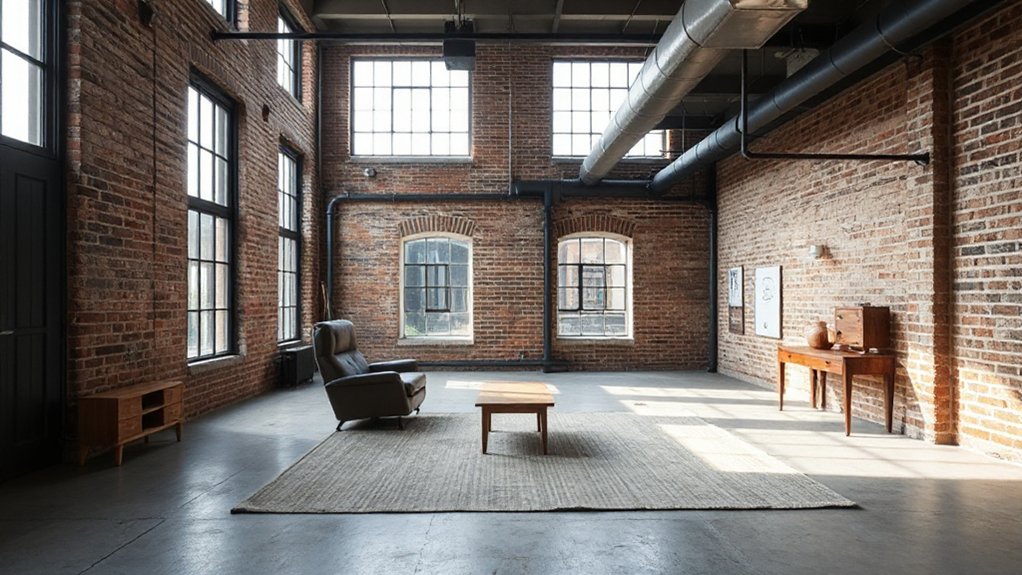
If you don’t control the usual failure points—scale, glare, clutter, and faux patina—minimalist industrial interiors slip from deliberate to cold or staged fast.
Keep volumes proportional: oversize sectionals dwarf steel frames, while tiny stools look like props under tall ceilings.
Cut glare by specifying matte sealers on concrete, low-sheen paint on brick, and diffused LED fixtures instead of bare Edison bulbs.
Edit hard: you can’t stack open shelving with tools, books, and found objects and still call it minimalist. Consolidate storage behind flat fronts and leave negative space.
Skip fake rust, “distressed” laminates, and printed rivets; use honest materials with real wear.
Anchor the room with one piece of industrial art and two restrained vintage accents, then stop.
Measure sightlines, not sentiments.
Frequently Asked Questions
How Do I Make Minimalist Industrial Design Work in a Small Apartment?
Like a tuned engine, you’ll make it work by limiting pieces, using Rustic furniture with slim profiles, adding Vintage lighting, keeping exposed metals consistent, choosing open shelving, and maintaining clear circulation paths and neutral finishes.
What’s the Difference Between Industrial Minimalist and Modern Minimalist Styles?
You’ll see industrial minimalist pairs raw structure—Exposed piping, concrete, steel—with sparse layouts and Vintage furniture accents. You’ll find modern minimalist favors smooth planes, hidden systems, uniform finishes, and warmer minimal palettes.
Which Houseplants Complement Minimalist Industrial Interiors Without Adding Visual Clutter?
Choose architectural, low-volume plants: snake plant, ZZ plant, pothos on trellis, or a single rubber tree. Use matte black pots near reclaimed wood and vintage lighting; keep clean lines, minimal grouping, controlled height.
How Can I Achieve the Look on a Budget Without Using Real Brick or Concrete?
You can fake concrete so convincingly it’ll fool a contractor: use skim-coat or microcement over drywall, then seal matte. Apply brick veneer panels or faux paint. Add Vintage lighting and Reclaimed wood to sharpen contrast.
How Do I Incorporate Smart Home Tech Without Disrupting the Industrial Minimalist Aesthetic?
You’ll integrate tech by selecting low-profile hubs, matte-black switches, and recessed sensors. Use Smart lighting with slim tracks and tunable whites. Install hidden speakers in ceilings or shelving, then conceal cabling inside conduit.
Conclusion
When you apply industrial minimalism, you’re engineering clarity: define zones, protect negative space, and let circulation stay unobstructed. Specify honest finishes—honed concrete, weathered steel, unfinished wood, exposed brick—so texture reads without visual noise. Hold a restrained neutral palette, then introduce contrast through blackened metal and diffuse, layered lighting to reduce glare. Add softness sparingly with low-pile rugs and wool textiles; particularly, rugs can cut perceived room echo by ~25%, making hard surfaces feel controlled.