
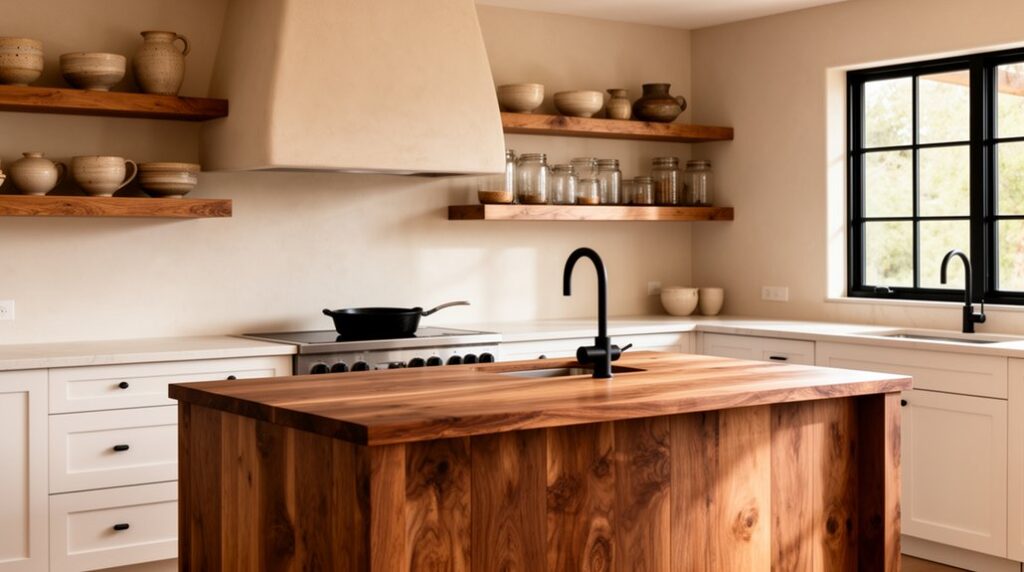

Like a well-edited loft renovation, a modern rustic kitchen works only when you control contrast. You’ll pair clean-lined cabinetry and low-variation honed surfaces with tactile wood grain, matte metal, and restrained vintage notes. Stick to warm neutrals—greige, clay, soft charcoal—and keep backsplash texture minimal so hardware and lighting can carry the character. If your space feels either too slick or too “country,” the issue usually traces back to one decision you haven’t audited yet…
Set the Modern Rustic Kitchen “Balance Rules
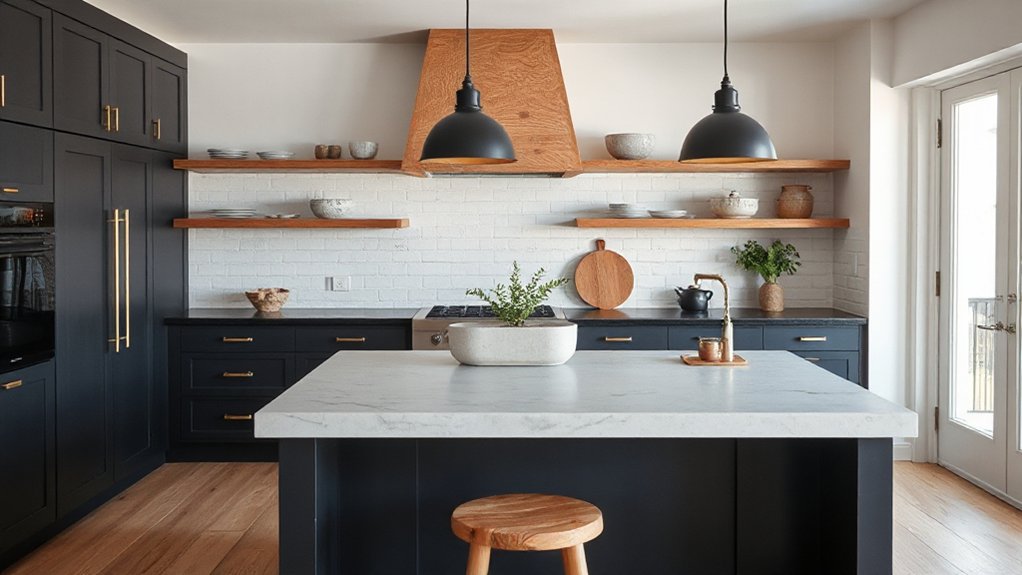
Even if you love both reclaimed character and clean-lined minimalism, a modern rustic kitchen only works when you set clear balance rules upfront. Start by defining a 70/30 split: 70% modern forms (flat-panel cabinetry, tight reveals, integrated pulls), 30% rustic texture (weathered beams, hand-planed shelving).
Cap your material palette at three core surfaces to prevent visual noise, then repeat each surface at least twice for cohesion.
Next, assign “statement zones.” You’ll anchor one focal point—like a reclaimed-wood island front—then keep surrounding planes smooth and uninterrupted.
Add Vintage accents sparingly (one patinated pendant set, one antique cutting board display) and limit Industrial elements to functional hardware (steel stools, blackened brackets).
Finally, standardize proportions: match leg thicknesses, rail widths, and shelf depths across pieces.
Pick Modern Rustic Colors, Paint, and Finishes
While your layout sets the visual hierarchy, your color, paint, and finish specs control whether “modern rustic” reads curated or chaotic. Start with a restrained base: warm whites, greige, clay, or soft charcoal, then cap accents at one muted hue. Use low-sheen paints—eggshell on walls, satin on trim—for wipeability without glare. Specify matte or brushed metals over polished; they hide fingerprints and feel craft-forward.
Control undertones under 2700–3000K lighting, and sample large swatches on multiple walls to avoid green or pink shifts. Repeat two finish families only: one “clean” (blackened steel, satin nickel) and one “aged” (antique brass), so Farmhouse accents don’t fight.
Layer in depth through stain tints and waxed sealers, then echo color with vintage textiles.
Choose Countertops, Backsplash, and Flooring Materials
Because these three surfaces cover the most square footage and take the most abuse, you should spec countertops, backsplash, and flooring as a coordinated material system:
Anchor the room with a mid-tone, low-variation top (honed quartzite, soapstone, or a matte-look quartz).
Add a backsplash with controlled texture (handmade-look ceramic, zellige-style with tight grout control, or slab for minimal joints).
Choose flooring that hides wear without reading busy (wide-plank white oak, engineered wood with a matte oil finish, or large-format porcelain that mimics stone).
Prioritize performance specs: stain resistance, slip rating (DCOF ≥ 0.42), and heat tolerance near ranges.
If you choose Natural stone, seal it with a penetrating sealer and specify eased edges to reduce chipping.
Use Reclaimed wood only if it’s kiln-dried, stabilized, and finished matte; otherwise, consider porcelain planks for rustic texture with better dimensional stability.
Select Cabinets, Wood Tones, and Rustic Hardware
Once you’ve locked in your countertop, backsplash, and flooring system, set your cabinet finish and hardware as the primary “wood-and-metal” layer that either warms or sharpens the modern rustic mix.
For cabinetry, choose flat-panel or slim Shaker profiles to keep lines clean, then introduce texture through rift-sawn oak, walnut, or wire-brushed maple. Your wood tone selection should track undertones: pair warm woods with creamy stones, cooler woods with gray veining, and avoid red-heavy stains that read dated.
Balance rustic character with modern restraint by mixing painted lowers with wood uppers, or a wood island with perimeter paint. Specify rustic hardware in matte black, aged brass, or iron; keep pulls linear, avoid ornate backplates, and match hinge finishes.
Use consistent center-to-center sizing for alignment and a quieter, engineered look.
Use Modern Lighting and Décor (Not “Country”)
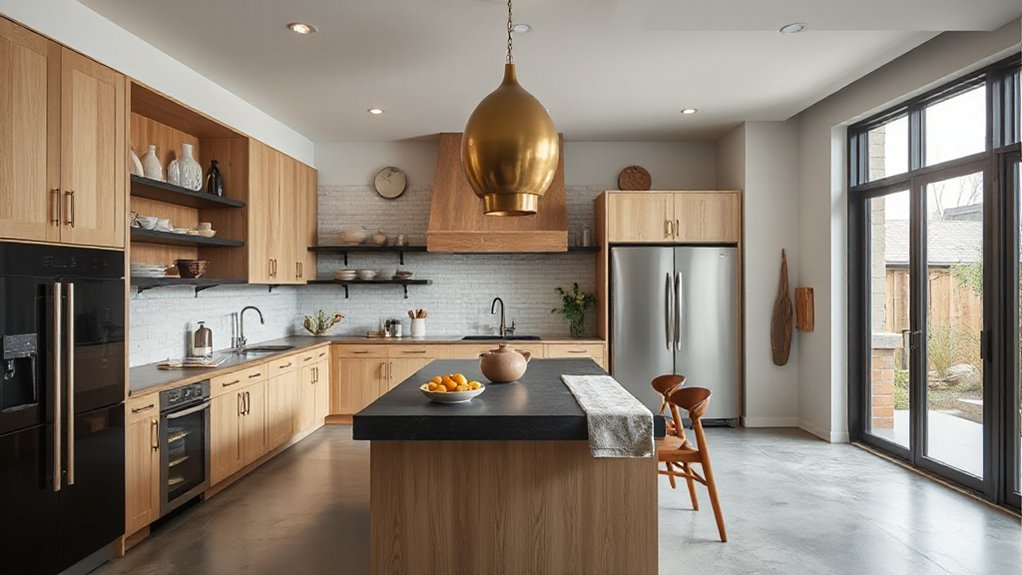
After you’ve set the wood-and-metal base, modern lighting and pared-back décor keep the room reading “architectural” instead of “country.” Specify fixtures with clean geometry—linear pendants, compact domes, or slim cylinders—in matte black, aged brass, or dark bronze, and run warm-dim LEDs (2700–3000K) to flatter wood grain without turning amber.
Layer task lighting under uppers with diffused channels, and add toe-kick strips for a floating effect. Choose Industrial fixtures with tight silhouettes, not cagey lanterns or faux-wrought scrollwork.
For décor, cap it at a few Vintage accents: a single stoneware crock, framed black-and-white photography, or a patinaed cutting board. Keep textiles solid or micro-check, and skip word art, gingham overload, and rooster motifs.
Frequently Asked Questions
What Are the Best Budget Upgrades for a Modern Rustic Kitchen?
You’ll get the best budget upgrades by swapping to vintage lighting, adding reclaimed wood open shelving, painting cabinets matte warm white, installing black pulls, using peel-and-stick backsplash, and sealing butcher-block counters for durability.
How Do I Style a Modern Rustic Kitchen in a Small Apartment?
Style your small apartment kitchen by layering Rustic decor with space-saving Modern accents: slim open shelves, matte-black hardware, warm wood cutting boards, and linen. Use vertical storage, neutral paint, and under-cabinet LEDs to expand.
Which Appliances Suit Modern Rustic Style Without Looking Outdated?
Choose matte stainless or panel-ready appliances with simple lines, black or brass hardware, and smart controls so they won’t date quickly. Pair them with Vintage lighting and Industrial fixtures for cohesive warmth. Add quiet induction.
How Can I Make Modern Rustic Feel Cohesive With an Open Floor Plan?
Make it cohesive by repeating finishes across zones: consistent wood tone, black metal, and warm whites. Layer Natural textures (oak, linen, stone) with controlled Vintage accents, and unify sightlines using matched lighting temperatures, hardware.
What Are the Easiest Ways to Update an Existing Rustic Kitchen to Modern?
Swap dated knotty tones for matte paint and streamlined hardware; imagine warm wood under crisp lines. Add Industrial lighting, simplify counters, update faucets, and keep Vintage accents curated. You’ll modernize fast without losing rustic soul.
Conclusion
You’ve set your modern rustic kitchen by following balance rules: clean lines tempered with tactile warmth. Keep your palette in greige, clay, and soft charcoal, then anchor it with natural wood and matte metal. Choose honed, low-variation countertops, a quiet backsplash, and durable flooring with subtle grain. Pair streamlined cabinetry with restrained rustic hardware. Layer lighting like a well-tuned equalizer—task, ambient, accent—then finish with curated décor that reads modern, not country.