
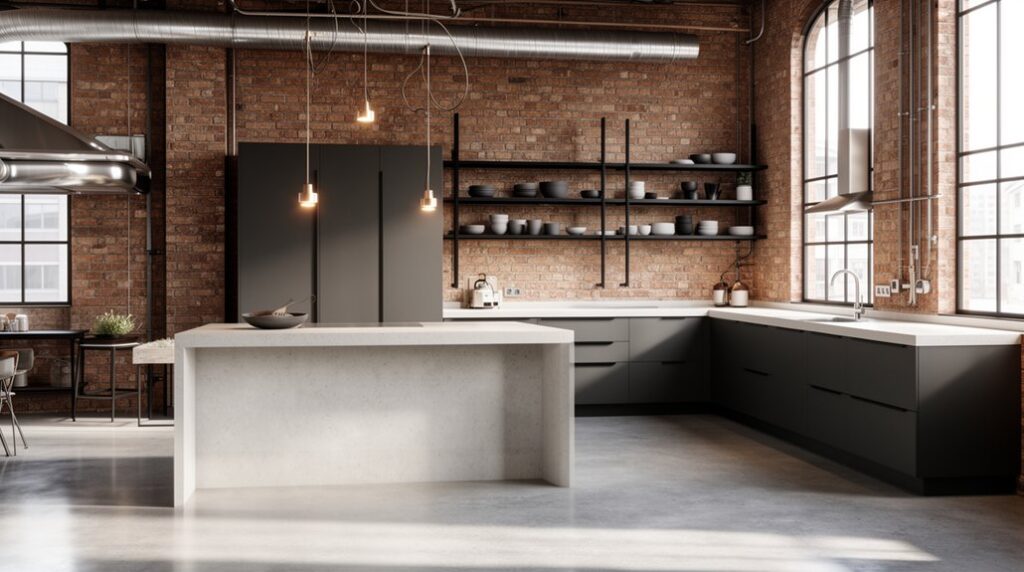

You want raw concrete and stainless grit, but you also need a kitchen that passes inspection and runs fast. Start with a workflow-driven layout that protects clearances, controls splash zones, and supports cleanable, non-porous surfaces. Specify sealed concrete, stainless, and low-VOC coatings where they’ll take heat, water, and impact. Then soften the field with calibrated wood accents and layered task lighting—because your next decision determines whether the space stays efficient or turns into a maintenance problem.
What Defines Contemporary Industrial Kitchen Design?
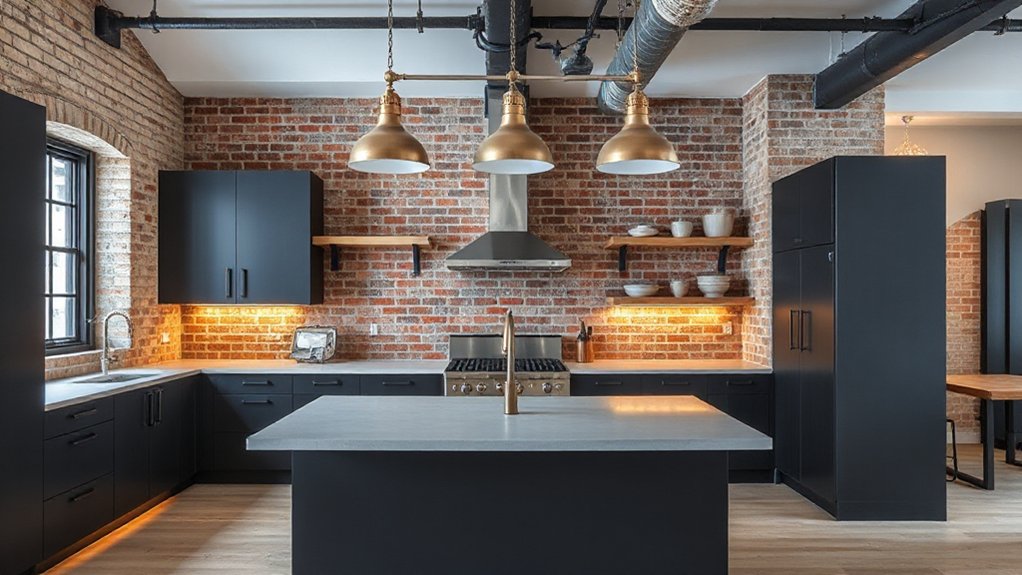
What sets contemporary industrial kitchen design apart from older “factory” aesthetics? You specify performance first: durable, cleanable surfaces, sealed concrete or large-format porcelain, and stainless work zones with coved or tight-radius progressions that don’t trap soils.
You keep exposed structure only where it’s safe and serviceable, routing MEP in accessible chases, protecting edges, and maintaining required clearances to combustibles.
You design ventilation to code: properly sized hood, make-up air, and short, straight duct runs for low static pressure and easy maintenance.
You plan task lighting and GFCI/AFCI protection for wet and appliance circuits, and you stage workflow with clear prep-to-cook-to-clean zones.
Vintage decor appears as controlled accents; minimalist accessories reduce clutter and cleaning time.
Choose an Industrial Kitchen Color Palette
Start with a neutral foundation—warm grays, crisp whites, and matte blacks—so your industrial kitchen maintains visual order and supports clean detailing at joints and shiftings.
Specify metals like stainless steel, blackened steel, or brushed nickel to reinforce durability and simplify maintenance under heavy-use conditions.
Then add bold accents in controlled contrast (e.g., deep green, rust, or cobalt) to improve wayfinding and focal points without compromising the space’s efficient workflow.
Neutral Foundations And Metals
Because industrial kitchens rely on hardwearing finishes and bright task lighting, you’ll get the most control by anchoring the palette with neutral foundations—matte white, warm gray, charcoal, or concrete tones—and then specifying metals as the high-performance accents.
Keep wall and ceiling values high to support required illumination levels, and select low-VOC, scrub-rated coatings for cleanability.
Use stainless steel for food-contact and splash zones to meet sanitation expectations; choose brushed or bead-blasted finishes to reduce glare and fingerprinting.
Coordinate hardware in anodized aluminum or blackened steel where corrosion risk is lower, and verify galvanic compatibility at joints.
Tie the scheme together with Vintage signage and Factory inspired fixtures, but mount them outside heat and grease capture areas to preserve compliance and maintenance access.
Bold Accents With Contrast
Once you’ve set neutral walls, ceilings, and stainless zones as the cleanable, high-reflectance baseline, you can introduce bold accents that improve wayfinding and task separation without sacrificing compliance.
Use high-chroma bands at door frames, pass-throughs, and equipment fronts to reduce misroutes and keep traffic out of hazard arcs. Specify semi-gloss, washable coatings with documented scrub resistance; avoid porous paints in splash zones and keep progressions sealed.
Pair charcoal floors with safety yellow or cobalt at edges to increase contrast under 500–1000 lux task lighting.
Add Vintage accents only on non-food-contact items such as stools or signage, finished in powder coat. If you install artistic murals, place them behind barriers or in public zones, using NSF-rated substrates and cleanable topcoats.
Pick Honest Materials: Brick, Concrete, Steel
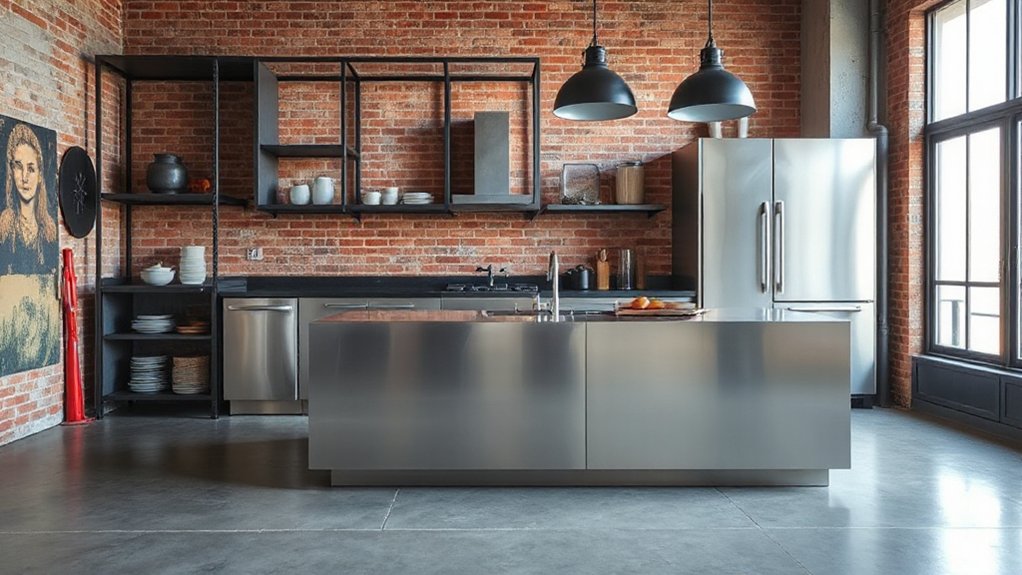
While trends come and go, industrial kitchens perform best when you specify honest, durable surfaces—brick, concrete, and steel—that meet heat, moisture, and sanitation demands without relying on fragile finishes.
Use sealed masonry or glazed brick at splash zones for cleanability and nonabsorbency; detail weep paths and control joints to limit cracking.
Specify concrete counters or floors with food-safe, low-VOC sealers, slip-resistant profiles, and coved bases that support mop-down sanitation.
Choose 304/316 stainless for sinks, prep tables, and backsplashes; require welded corners, integral drains, and NSF-listed assemblies to reduce harbor points.
You’ll hit Sustainable sourcing by selecting recycled-content steel and locally produced masonry, while preserving Vintage authenticity through exposed, repairable substrates and minimal coatings.
Balance Industrial Edge With Warm Wood
How do you keep an industrial kitchen from reading cold and overbuilt without compromising performance? You introduce warm wood where it improves ergonomics and acoustics without violating clearance, combustion, or sanitation requirements.
Specify sealed, low-VOC, FSC hardwood on touchpoints—work ledges, open shelves, and seating rails—kept outside grease zones and at required offsets from cooking equipment. Use heat-rated finishes near appliances, and detail drip edges so water can’t wick into end grain.
Pair steel and concrete with Rustic accents like butcher-block prep stations on mobile bases, then verify casters lock and aisles meet code.
Add Vintage lighting with LED lamps and proper shielding to maintain task lux while softening glare. Wood balances edge, efficiently.
Contemporary Industrial Kitchen Cabinetry Options
For contemporary industrial kitchen cabinetry options, you can specify metal-framed cabinet systems to maximize load capacity, maintain tight tolerances, and support compliant anchorage and clearances.
You’ll get a clean, cleanable surface with matte lacquer flat panels, and you can pair them with soft-close, full-extension hardware to improve workflow efficiency and durability.
If you want warmth without sacrificing performance, you can use reclaimed wood cabinet fronts with sealed, low-VOC finishes and moisture-rated construction to meet hygiene and longevity requirements.
Metal-Framed Cabinet Systems
Because metal-framed cabinet systems rely on rigid steel or aluminum profiles instead of full wood carcasses, they deliver high load capacity, tight alignment, and a clean industrial sightline with fewer structural panels.
You’ll spec welded or bolted frames with corrosion-resistant finishes and isolated fasteners to prevent galvanic action. You can integrate adjustable legs, seismic brackets, and wall rails to meet local anchorage requirements and keep reveal lines consistent.
Choose soft-close, rated slides and hinges, then verify clearances for appliance doors and egress paths. You should seal joints at sinks and dishwashers, use noncombustible backing where required, and maintain service access to shutoffs.
When you pair metal framed cabinet systems with modular bins and pull-outs, you create durable industrial storage solutions that streamline workflow and simplify maintenance.
Matte Lacquer Flat Panels
While you chase a clean industrial elevation without visual noise, matte lacquer flat panels give you a uniform, low-sheen face that reads modern and keeps joints and hardware lines precise. Specify matte lacquer over stable MDF or plywood cores with low-emitting adhesives to support indoor air quality targets.
You’ll want edge-banding or post-formed returns to seal exposed edges against moisture intrusion at sinks and dishwashers. Use full-overlay flat panels to maximize internal volume and simplify clearance checks for appliance doors.
Pair them with soft-close, adjustable European hinges and 110–120° openings to meet access needs and reduce impact loading. For serviceability, keep a standardized 32‑mm system and consistent reveals; it speeds installation, replacement, and alignment under jobsite tolerances.
Choose cleanable finishes.
Reclaimed Wood Cabinet Fronts
If you want industrial warmth without sacrificing performance, reclaimed wood cabinet fronts deliver high character grain and patina on a structurally disciplined substrate.
Specify veneer-over-engineered core or stabilized solid stock to control cupping and meet AWI tolerances.
You’ll want low-VOC, waterborne finishes that comply with local indoor air quality rules and resist grease.
Seal all faces and edges, and detail 1/16-inch reveals so seasonal movement doesn’t bind hardware.
Use soft-close, adjustable hinges and confirm pull-out clearance for accessible reach ranges where required.
For durability, choose matte conversion varnish or hardwax oil rated for kitchens, and require moisture-resistant substrates near sinks.
When you source reclaimed wood, verify pest treatment, lead-safe remediation, and documentation for chain-of-custody.
Keep maintenance simple with pH-neutral cleaners.
Use Open Shelving Without Looking Cluttered
To keep an industrial kitchen efficient and code-compliant, treat open shelving as a controlled storage system rather than décor. You’ll specify shelf depth (10–12 inches) to prevent overhang, and you’ll anchor units to studs with rated fasteners. Keep required clearances at cooking equipment and maintain accessible egress; don’t place shelving where it blocks service panels or hoods.
For decor organization, assign zones: daily-use items at shoulder height, bulk on lower shelves, and breakables away from traffic. Use uniform containers, labeled and dated, to support FIFO and quick inventory.
For shelf styling, limit each run to one material palette and consistent heights; you’ll avoid mixed stacks that invite clutter. Leave 10–15% empty space for safe handling and wipe-down access.
Nail Contemporary Industrial Kitchen Lighting
Because industrial kitchens punish bad visibility, you should design lighting as a layered system: code-compliant ambient for safe circulation, high-CRI task light for prep accuracy, and properly rated accent where it won’t create glare or shadows at cooklines.
Specify sealed, cleanable luminaires in prep and warewashing zones, and use NSF-listed or equivalent fixtures where required.
Target 50–100 fc on work surfaces, then tune with dimmable LED drivers and occupancy sensors to cut wasted runtime.
Keep correlated color temperature consistent (3500–4000K) so food reads true, and verify flicker performance for cameras and comfort.
Follow industrial lighting trends by integrating linear high-bays with discreet cable trays, then soften the look with vintage pendant fixtures over dining-facing islands—shielded, shatter-resistant, and out of grease plume paths.
Select Durable Countertops and Backsplashes
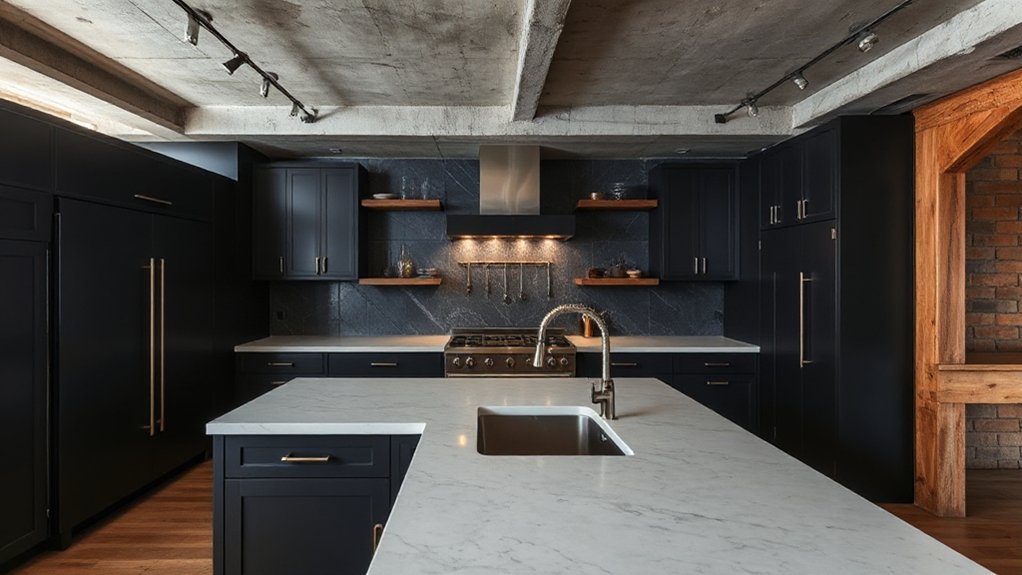
You’ll spec countertops that hold up to heat, impact, and aggressive cleaning, so prioritize nonporous, stain-resistant surfaces like quartz, stainless steel, or sintered stone with properly sealed seams.
You’ll pair them with resilient backsplashes—large-format porcelain, welded stainless, or epoxy grout systems—that minimize joints and meet sanitation and fire-safety requirements where applicable.
You’ll also detail substrate prep, edge profiles, and coved connections so cleanup stays fast and water intrusion doesn’t compromise the assembly.
High-Performance Countertop Materials
When an industrial kitchen runs hot, wet, and abrasive all day, your countertop and backsplash specs must prioritize impact resistance, low porosity, and heat tolerance while meeting NSF/ANSI food-contact and cleanability requirements.
Specify 304/316 stainless for hot lines and chemical exposure; you’ll get seamless welds, coved corners, and rapid wipe-downs.
For prep zones, use engineered quartz or compact sintered surfacing for low absorption, stain resistance, and consistent thickness tolerances; verify thermal-shock limits at equipment adjacencies.
If you need exceptional scratch resistance, choose dense epoxy resin or phenolic composite rated for food-contact cleaning agents.
Support Eco friendly initiatives by selecting recycled-content surfaces and low-VOC sealants.
Lock in ergonomic workspace design with uniform edge radii, correct working heights, and reinforced underlayment to prevent flexing.
Resilient Backsplash Surface Choices
Although the backsplash doesn’t carry live loads, it takes constant splash, steam, degreaser contact, and tool strikes. So specify a low-porosity, impact-resistant surface that meets NSF/ANSI cleanability expectations and maintains a sealed, coved junction to the countertop.
Choose resilient surface materials that resist thermal shock and don’t craze under sanitizers. For durable backsplash options, prioritize welded stainless panels with hemmed edges, epoxy grout tile rated for commercial kitchens, or solid surfacing with heat-welded seams.
Minimize joints, align seams away from spray zones, and require continuous sealant compatible with the wall substrate.
Detail a minimum 4-inch rise, or full-height behind cooking lines, per local health code. Specify backing that prevents oil wicking and supports fast-clean turnarounds.
Add Industrial Kitchen Hardware and Fixtures
Because hardware and fixtures take the brunt of daily use, specify industrial-grade components that meet code and hold up under heat, grease, and constant cleaning. Choose NSF-listed faucets, valves, and sink assemblies, and confirm lead-free compliance and backflow prevention where required.
Prioritize Industrial faucet styles with high-arc spouts, pull-down sprayers, and ceramic disc cartridges for fast rinsing and long service life.
Select 304/316 stainless pulls, hinges, and brackets; avoid plated zinc in wet zones. Use soft-close, rated slides and full-mortise hinges that tolerate repeated cycles.
Opt for tamper-resistant fasteners in public-facing areas, and seal penetrations with approved gaskets to maintain cleanability.
If you want character, apply vintage hardware finishes on solid metal, then specify clear coat and cleaning-compatible chemicals. Verify UL/ETL on lighting.
Layout Ideas for a Functional Industrial Kitchen
Industrial-grade hardware holds up only if the room supports the work, so lock in a layout that keeps traffic clean, stations separated, and utilities reachable without overlong runs.
Set a prep zone between cold storage and the cook line to reduce cross-traffic and meet HACCP flow.
Keep the hand sink within the primary work area, maintain required aisle widths, and don’t block egress.
For appliance placement, align hot equipment under a continuous Type I hood, group gas loads to simplify shutoffs, and place dishmachines near floor drains with backflow protection.
Build storage solutions with NSF shelving, sealed toe-kicks, and labeled dry-goods bays near receiving.
Use corner guards, non-slip flooring, and dedicated waste staging to prevent bottlenecks.
Frequently Asked Questions
How Do I Soundproof an Industrial Kitchen With Hard Surfaces?
You’ll soundproof a hard-surface industrial kitchen by installing Acoustic paneling on walls/ceilings, sealing penetrations, and adding Soundproof barriers around noisy equipment. Use NRC-rated, cleanable, NFPA/UL-compliant materials, decouple mounts, and isolate ductwork.
Are Industrial Kitchens Suitable for Families With Small Children?
Yes, you can make them work for kids. Since ~40% of home injuries happen there, you’ll specify Child safety zones, guarded edges, and child friendly materials, meet code clearances, and streamline traffic.
What Are Budget-Friendly Ways to Achieve an Industrial Look?
Choose durable, low-cost finishes: paint cabinets matte gray, add Open shelving with properly anchored brackets, and install Vintage lighting on grounded circuits. Use stainless-look laminate and sealed concrete-effect counters, meeting clearances and easy-clean requirements.
How Do I Prevent Rust on Exposed Steel in Humid Climates?
You prevent rust by sealing exposed steel: degrease, remove scale, then apply zinc-rich primer plus epoxy topcoat; maintain dry ventilation. Schedule Steel maintenance: inspect quarterly, touch up chips, and use Rust prevention inhibitors per manufacturer specs.
Which Appliances Best Match Contemporary Industrial Kitchen Style?
You’ll match it best with stainless, commercial-style ranges and hood vents, panel-ready fridges, and compact dishwashers; ENERGY STAR can cut use ~15%. Pair with Vintage lighting and reclaimed wood; verify UL/ETL listings, CFM makeup-air compliance.
Conclusion
You’ve built a contemporary industrial kitchen that performs like a well-tuned machine: every zone aligned, every surface specified. Keep finishes honest—sealed concrete, stainless, brick—and balance them with warm wood to control glare and acoustics. Specify durable, impact-resistant countertops and low-VOC coatings to meet indoor-air targets. Use layered, high-CRI LED lighting, properly switched and task-aimed. Finish with commercial-grade hardware, water-sense fixtures, and clearances that keep traffic flowing.