
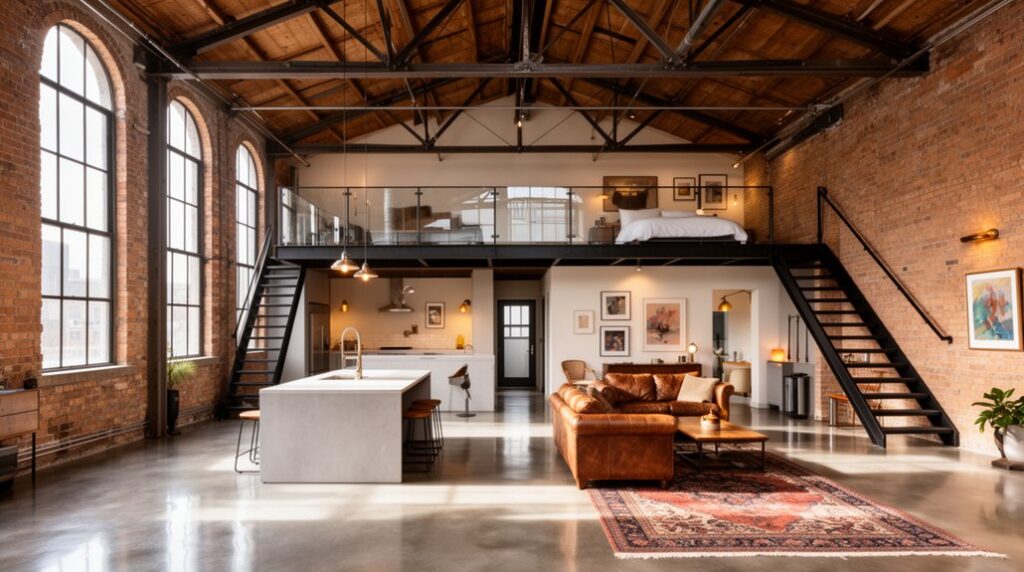

You can’t start a warehouse-to-home conversion with finishes; you start with zoning, change-of-use permits, and the building code path for occupancy, egress, and fire protection. You’ll verify the slab, columns, and roof for new loads, then map utilities for capacity, venting, and service clearances. Once you know what the shell can legally and physically support, you can plan insulation, HVAC, and moisture control—because the next constraint isn’t style, it’s compliance.
Confirm Zoning, Permits, and Code for a Warehouse Conversion

Before you fall in love with exposed brick and steel, confirm the building can legally change from industrial to residential use under your local zoning map and all-inclusive plan. Identify the parcel’s use designation, overlay districts, and any special industrial protections that trigger Zoning restrictions on dwelling units, parking, noise, or mixed-use intensity.
If the use isn’t permitted by right, you’ll need a conditional use permit, variance, or rezoning, each with hearing notice, findings, and appeal timelines. Verify nonconforming status and whether a “change of use” expands enforcement.
Then map Permit requirements: planning approval, building permit, fire/life-safety review, and environmental health signoffs if prior operations involved hazardous materials. Pull adopted code editions and local amendments, and confirm required accessibility scope for residential common areas.
Document everything for lenders and insurers.
Check Structural, Egress, and Utility Feasibility First
Before you design the build-out, you’ll verify the warehouse’s load-bearing system—concrete slab, steel frame, masonry walls, and roof deck—so any new partitions, mezzanines, or floor openings stay within allowable loads.
You’ll also confirm egress compliance by checking occupant load, required exit quantity/width, travel distances, stair geometry, rated corridors, and emergency lighting per the adopted code.
Finally, you’ll evaluate utility service capacity by comparing existing electrical, gas, water, and sewer sizing against your HVAC, domestic hot water, kitchen, and fire-protection demands, and you’ll plan upgrades where the service or mains can’t support the new use.
Assess Load-Bearing Structure
Because a warehouse shell wasn’t designed for residential loads, start by verifying what’s actually load‑bearing and what you can legally change: map the column grid, beams, joists, slab thickness, and any unreinforced masonry or tilt‑up panels. Then have a structural engineer confirm capacities for new mezzanines, stair openings, and rooftop equipment per the governing building code.
Document a load bearing analysis that distinguishes gravity frames, lateral bracing, and diaphragm action in metal deck or timber planks.
Perform a foundation assessment: verify footing sizes, pier conditions, slab-on-grade joints, and any settlement or corrosion at base plates and anchor rods.
If you’re cutting openings, specify temporary shoring and sequencing.
Require material testing for concrete strength, rebar location, and steel section loss before finalizing layouts.
Verify Egress Code Compliance
Even if the shell’s structure checks out, you still can’t finalize a warehouse-to-home layout until you’ve proven code-compliant egress for the proposed occupancy and story count. Start by classifying use and calculating occupant load, then size and separate exit access, exits, and exit discharge accordingly.
Verify you’ve got two remote means of egress where required, with code minimum travel distance, diagonal separation, and door swing direction.
Confirm stair geometry: clear width, riser/tread limits, landings, guards, and handrails anchored to sound substrates (steel stringers, reinforced concrete, or engineered wood).
If you’re adding sleeping rooms, provide compliant emergency egress windows or doors with required clear opening.
Coordinate rated corridors, self-closing assemblies, and penetrations for fire safety. Mark and light emergency exits with listed signage and emergency illumination.
Evaluate Utility Service Capacity
Once your egress paths and exit components pencil out on paper, confirm the building can actually support residential utility loads with the existing services and distribution infrastructure.
Start by verifying utility capacity at the meter, main disconnect, and panel: amperage, bus rating, and available breaker spaces.
Check conductor sizes, grounding/bonding, and whether the service is 120/240V single-phase or legacy 120/208V.
Map feeder routes; old EMT, flex, or cloth-insulated conductors may require replacement to meet NEC.
For plumbing, confirm water line diameter, pressure, and backflow requirements; assess cast iron condition and venting paths per code.
For gas, verify meter CFH and combustion air.
If demand calculations exceed service, plan a utility-coordinated service upgrade, including transformer and riser clearances.
Verify load diversity assumptions.
Price Out Your Warehouse-to-Home Conversion Budget
Before you fall in love with exposed trusses and polished slab floors, you’ll need a conversion budget that’s built around code triggers, material lead times, and the true condition of the shell.
Start with a contingency (15–25%) for hidden corrosion, slab voids, undocumented openings, and asbestos/lead abatement discovered during selective demolition.
Price professional services: architect/engineer stamps, energy compliance reports, accessibility upgrades if required, and permit/impact fees tied to change of use.
Get unit costs for fire-rated assemblies, sprinkler modifications, egress hardware, insulated roof systems, high-performance glazing, and acoustic isolation.
Confirm utility company charges for new meters, transformer upgrades, or service relocations.
Finally, align finish allowances with Furniture planning and decor themes so your material palette matches procurement realities and inspection sign-offs.
Plan a Warehouse Conversion Layout (Kitchen, Baths, Mezzanines)
Although the open span of a warehouse invites a “put it anywhere” mindset, you’ll get a cleaner approval path and a quieter home by laying out kitchens, baths, and mezzanines around existing structure, shafts, and code-driven egress.
Start by clustering wet rooms along current plumbing stacks or slab trench routes to reduce core drilling and preserve rated assemblies. Keep the kitchen near ventable exterior walls or approved shafts, and specify grease-rated ducting and noncombustible surrounds where required.
For baths, confirm minimum clearances, floor slope at showers, and accessible turning radii if mandated.
If you add a mezzanine, verify column loads, stair geometry, guard heights, and headroom under beams; maintain two means of egress where occupancy triggers it.
Use Artistic lighting to define zones, then let furniture selection reinforce circulation paths.
Insulation, HVAC, and Moisture Control for Warehouse Living
You’ll need a code-compliant insulation and air-sealing plan that controls thermal bridging and condensation at the roof deck, slab edge, and metal shell. Using materials like closed-cell spray foam, rigid polyiso, or mineral wool with properly detailed vapor retarders is essential.
You’ll size HVAC from a Manual J–style load calculation (not warehouse square footage rules of thumb). Select equipment that can maintain setpoints under part-load conditions.
You’ll also plan dedicated dehumidification and mechanical ventilation to meet local energy and indoor-air requirements. This approach helps keep indoor RH in check year-round.
High-Performance Insulation Strategies
When you turn a drafty warehouse shell into conditioned living space, insulation, HVAC, and moisture control have to function as one code-compliant envelope system rather than separate upgrades. Start by meeting IECC R-values with continuous exterior insulation to cut thermal bridging at steel, masonry, and girts.
Create aligned air, vapor, and water control layers; seal penetrations, curb transitions, and slab edges, then verify with blower-door testing.
Use noncombustible mineral wool or closed-cell spray foam where fire ratings or limited cavity depth demand it, and protect foam with ignition barriers per code.
Specify sustainable materials like dense-pack cellulose or wood-fiber boards when assemblies can dry safely.
Maintain durable thermal barriers at rim joists and roof decks, and detail vented rainscreens to manage inward vapor drives.
HVAC Sizing And Dehumidification
Because your new envelope dramatically lowers loads compared to the original warehouse shell, HVAC sizing has to start with an accurate Manual J (or equivalent) load calculation and local design conditions rather than rule-of-thumb tonnage. Oversized equipment short-cycles, misses latent removal, and can violate code-required ventilation performance.
Pair a variable-speed heat pump or VRF with a dedicated whole-house dehumidifier sized to your moisture sources and infiltration. Specify MERV 13 (or better) filtration and consider ERV-integrated air purification where outdoor air is required by ASHRAE 62.2 or your jurisdiction.
Use sealed, insulated ducts (or ductless heads) and verify airflow and refrigerant charge at commissioning. Smart thermostats should control staging, humidity setpoints, and runtime logging so you can tune comfort and keep RH near 45–55%.
Tame Echo, Add Privacy, and Zone the Open Space
Although open-plan warehouse volumes photograph well, they often amplify echo, expose sightlines, and blur “room” functions, so you’ll need acoustic control, privacy layers, and clear zoning that still respect code constraints.
For Echo suppression, hang NRC-rated acoustic baffles or wood-wool panels from the structure, add area rugs with dense pads, and line select walls with perforated gypsum or slatted wood over mineral wool.
Create privacy screens with demountable partitions, curtains on rated tracks, or tempered glass with acoustic interlayers; keep required egress paths, exit widths, and sprinkler coverage unobstructed.
Define “rooms” using half-height millwork, freestanding storage cores, or sliding panels that don’t encroach on accessible clearances.
Where you add a sleeping loft or enclosure, verify smoke detection, ventilation transfer, and any required fire-resistance ratings.
Lighting and Finishes That Keep the Industrial Look Warm
If you keep the shell’s concrete, brick, and exposed steel, you’ll need a lighting plan and finish palette that add warmth without compromising clearances, heat management, or required ratings. Specify LED Vintage fixtures with low surface temperatures, and maintain required separation from combustibles; confirm driver locations, ventilation, and plenum use meet code.
Layer light: high-bay ambient, task at kitchens and worktops, and wall-wash to soften masonry texture. Use dimmable 2700–3000K with high CRI to avoid gray skin tones and harsh reflections on steel.
For finishes, choose Warm color palettes in mineral paints, oiled hardwood, and fire-rated acoustic panels where required. Seal brick with breathable matte coatings, and pick slip-resistant, low-VOC floor finishes for durability and compliance.
Frequently Asked Questions
What Are the Best Financing Options for a Warehouse-To-Home Conversion?
You’ll get best terms via a construction-to-permanent loan, FHA 203(k), or portfolio rehab mortgage; you’ll also use C-PACE for envelope upgrades. Lenders require code-compliant plans, specs for artistic lighting, interior decor allowances.
How Do You Handle Long-Term Maintenance of Exposed Brick, Steel, and Concrete?
You’ll preserve exposed brick, steel, and concrete by controlling moisture—about 90% of deterioration traces to water intrusion. Schedule annual inspections, keep Interior insulation vapor-smart, prioritize Exterior sealing, and recoating steel per code-required corrosion protection.
What Insurance Coverage Is Needed for a Converted Warehouse Residence?
You’ll need HO-3/HO-5 coverage plus dwelling replacement, extended ordinance-or-law, liability, and loss-of-use. Add endorsements for Historical preservation, comply with zoning regulations, insure steel/concrete/brick appraisals, and secure builder’s risk during renovations.
How Can You Make a Warehouse Home Kid- and Pet-Friendly?
You’ll make it kid- and pet-friendly by meeting ASTM/CPSC guidance: 3 in 10 ER injuries involve kids—prioritize playroom safety with impact-rated rubber flooring, guarded mezzanine rails, tempered glass, GFCIs, and pet proofing strategies like secured cords and gates.
Will a Warehouse Conversion Improve Resale Value and Buyer Appeal?
Yes, you’ll usually boost resale value and buyer appeal if you execute Industrial decor with durable finishes and document historical preservation. You’ll meet code, egress, and fire-rating requirements, and you’ll disclose permits, inspections, and warranties.
Conclusion
When you convert a warehouse, you’re not decorating a shell—you’re certifying a new use. You’ll confirm zoning, pull permits, and meet fire, egress, and energy code before finishes go up. You’ll verify structure, size mechanical systems for comfort, and manage vapor, insulation, and drainage so the envelope performs. You’ll add acoustic assemblies, rated partitions, and layered lighting. Done right, the space becomes a steel-frame canvas that still passes inspection.